News

Navigating Singapore's DC Scarcity_ From Crowded Colos to In-House Strains

Navigating Singapore’s DC Scarcity: From Crowded Colos to In-House Strains

Navigating Singapore’s DC Scarcity: From Crowded Colos to In-House Strains

Singapore’s data centre market has never been busier — or harder to get into. For enterprises trying to secure capacity, or IT teams quietly absorbing the strain across their own sites, scarcity isn’t an abstract market condition. It shows up in three very practical ways: not enough colocation space, not enough hands to run in-house infrastructure well, and hidden costs that only surface years into ownership.

Colocation Capacity Shortage

The scarcity has structural roots. Singapore paused new data centre construction in 2019, concerned that facilities already consumed roughly 7% of national electricity. The moratorium held until 2022, when regulators introduced a selective approval regime — the Data Centre Call for Application (DC-CFA) — that only releases new capacity to operators meeting strict sustainability and efficiency criteria.

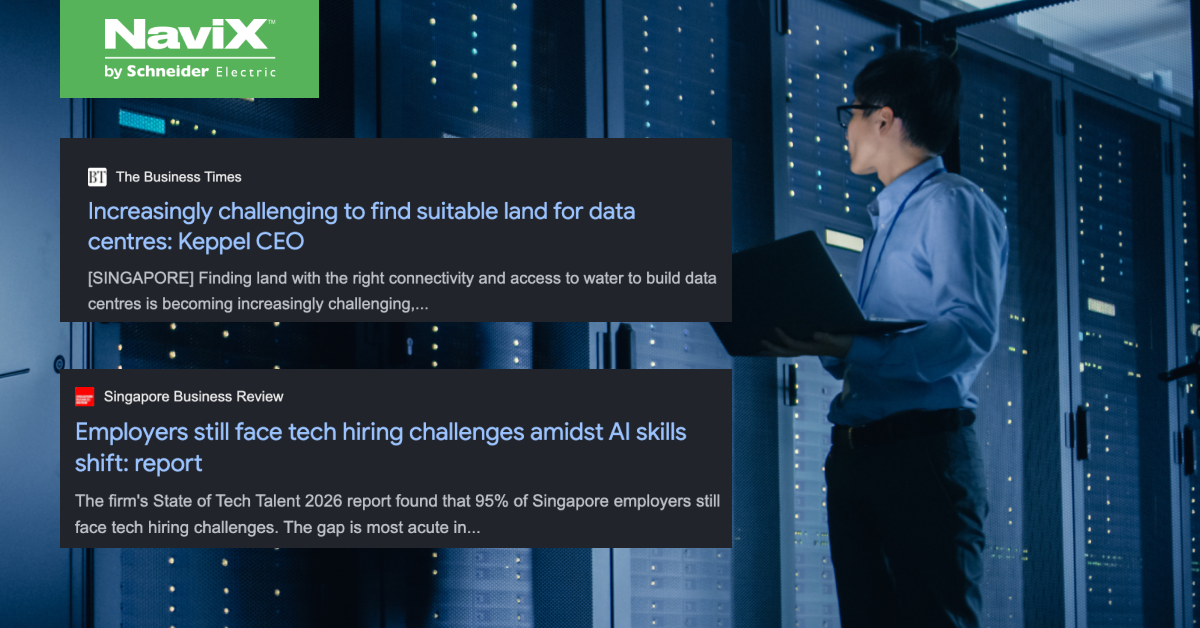
The effect on the ground: colocation vacancy sat at just 1.4% as of December 2024, among the tightest in Asia Pacific, and industry outlooks for 2026 still describe supply as structurally low, with available space too fragmented for many large deployments. Colocation now runs among the most expensive in the world at roughly USD 13.80 per watt, and with power availability now the binding constraint across the region, even newly approved capacity takes years to materialise.

Enterprises with latency-tolerant workloads are increasingly looking across the Causeway, where Johor’s data centre capacity has grown to over 1,110MW operational. But for workloads that need to stay onshore for compliance or data residency reasons, that escape valve isn’t always available — which pushes more enterprises back toward running infrastructure themselves.

Manpower Limits for On-Premise Execution Across Multi-Sites

Running one server room is manageable. Running several — branches, warehouses, regional offices — each needing the same power, cooling, and monitoring discipline, is a different problem. Singapore’s tropical humidity (75–95% year-round) makes it harder still: rooms fitted into buildings never designed for them need specialist, recurring attention, not a one-time setup.

Multiply that across sites and the requirement stops being “an IT generalist checks in occasionally” and becomes a standing operational function — someone on call for fault response and maintenance at every site. Most IT teams were never resourced for this; the electrical, mechanical, and environmental skill set involved is scarce industry-wide.

TCO Blind Spots for Data Center Fitouts

Lifecycle Cost / TCO Blind Spots

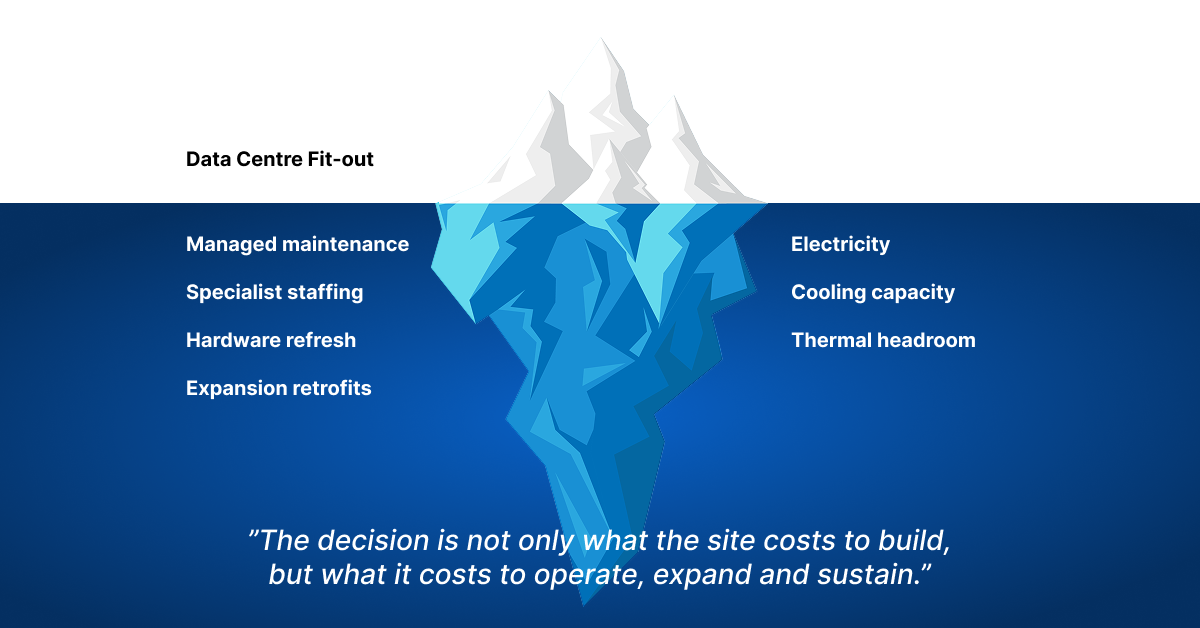
The sticker price is rarely the real cost. A typical fit-out might budget 5 to 6 figures for cooling and power alone, before the electricity, maintenance, and eventual hardware refresh that follow for years after. A common, costly mistake: cooling sized for today’s rack load with no thermal headroom for tomorrow’s, forcing an expensive retrofit the moment compute needs grow.

Ongoing costs compound it — managed maintenance can run 3 to 4 figures a month per site, or an unbudgeted headcount cost if kept in-house. None of this shows up in the initial capital estimate, and by the time it surfaces, it’s already locked in.

Closing The Gap

None of these three pressures are solved by choosing between colocation and on-premise — they’re solved by rethinking how infrastructure gets delivered in the first place. At NaviX Solutions, we see this shift already underway: enterprises moving from owning and staffing their infrastructure to subscribing to it as an outcome, with power, cooling, and monitoring engineered and maintained as a service rather than a one-off capital project.


NaviX Solutions provides zero-CAPEX, subscription-based critical power and cooling solutions for Singapore’s enterprises and commercial building operators

You may like:

The CIO’s playbook for hybrid cloud amid rising AI adoption Cloud repatriation is back on the CIO’s agenda. Forrester’s Cloud Survey found …

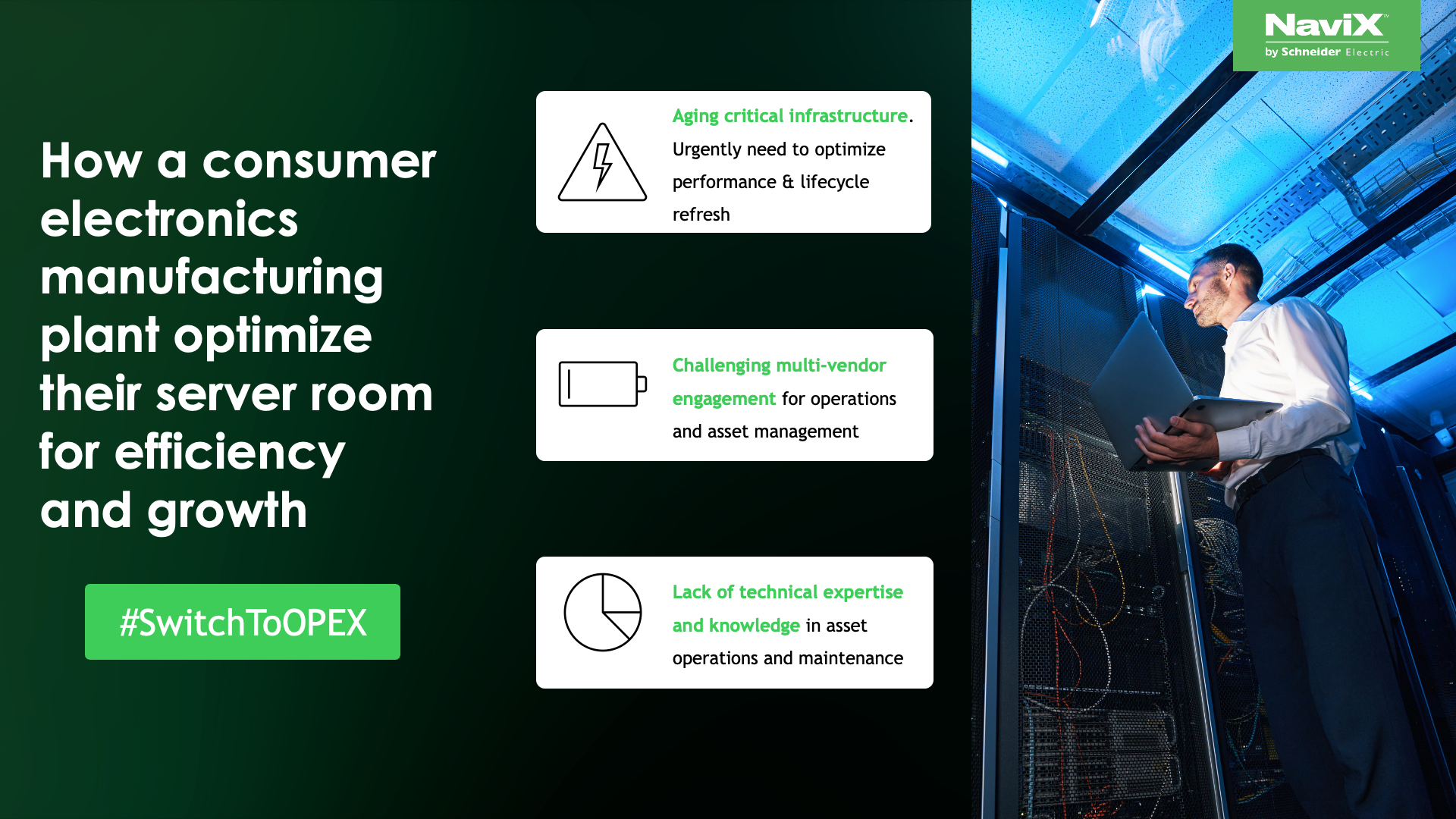
How a consumer electronics manufacturing plant optimize their server room for efficiency and growth Explore Enterprise DC as a Service Learn more: …

Navigating Singapore’s DC Scarcity: From Crowded Colos to In-House Strains

Singapore’s data centre market has never been busier — or harder to get into. For enterprises trying to secure capacity, or IT teams quietly absorbing the strain across their own sites, scarcity isn’t an abstract market condition. It shows up in three very practical ways: not enough colocation space, not enough hands to run in-house infrastructure well, and hidden costs that only surface years into ownership.

Colocation Capacity Shortage

The scarcity has structural roots. Singapore paused new data centre construction in 2019, concerned that facilities already consumed roughly 7% of national electricity. The moratorium held until 2022, when regulators introduced a selective approval regime — the Data Centre Call for Application (DC-CFA) — that only releases new capacity to operators meeting strict sustainability and efficiency criteria.

The effect on the ground: colocation vacancy sat at just 1.4% as of December 2024, among the tightest in Asia Pacific, and industry outlooks for 2026 still describe supply as structurally low, with available space too fragmented for many large deployments. Colocation now runs among the most expensive in the world at roughly USD 13.80 per watt, and with power availability now the binding constraint across the region, even newly approved capacity takes years to materialise.

Enterprises with latency-tolerant workloads are increasingly looking across the Causeway, where Johor’s data centre capacity has grown to over 1,110MW operational. But for workloads that need to stay onshore for compliance or data residency reasons, that escape valve isn’t always available — which pushes more enterprises back toward running infrastructure themselves.

Manpower Limits for On-Premise Execution Across Multi-Sites

Running one server room is manageable. Running several — branches, warehouses, regional offices — each needing the same power, cooling, and monitoring discipline, is a different problem. Singapore’s tropical humidity (75–95% year-round) makes it harder still: rooms fitted into buildings never designed for them need specialist, recurring attention, not a one-time setup.

Multiply that across sites and the requirement stops being “an IT generalist checks in occasionally” and becomes a standing operational function — someone on call for fault response and maintenance at every site. Most IT teams were never resourced for this; the electrical, mechanical, and environmental skill set involved is scarce industry-wide.

TCO Blind Spots for Data Center Fitouts

Lifecycle Cost / TCO Blind Spots

The sticker price is rarely the real cost. A typical fit-out might budget 5 to 6 figures for cooling and power alone, before the electricity, maintenance, and eventual hardware refresh that follow for years after. A common, costly mistake: cooling sized for today’s rack load with no thermal headroom for tomorrow’s, forcing an expensive retrofit the moment compute needs grow.

Ongoing costs compound it — managed maintenance can run 3 to 4 figures a month per site, or an unbudgeted headcount cost if kept in-house. None of this shows up in the initial capital estimate, and by the time it surfaces, it’s already locked in.

Closing The Gap

None of these three pressures are solved by choosing between colocation and on-premise — they’re solved by rethinking how infrastructure gets delivered in the first place. At NaviX Solutions, we see this shift already underway: enterprises moving from owning and staffing their infrastructure to subscribing to it as an outcome, with power, cooling, and monitoring engineered and maintained as a service rather than a one-off capital project.


NaviX Solutions provides zero-CAPEX, subscription-based critical power and cooling solutions for Singapore’s enterprises and commercial building operators

Learn more:

Enterprise DC as-a-Service
Critical IT Power as-a-Service
Critical IT Cooling as a Service
UPS Trade-In Program

Navigating Singapore’s DC Scarcity: From Crowded Colos to In-House Strains Read More »

CIO Playbook for Hybrid Cloud Amid Rising AI Adoption

CIO’s Playbook for Hybrid Cloud Amid Rising AI Adoption

The CIO’s playbook for hybrid cloud amid rising AI adoption

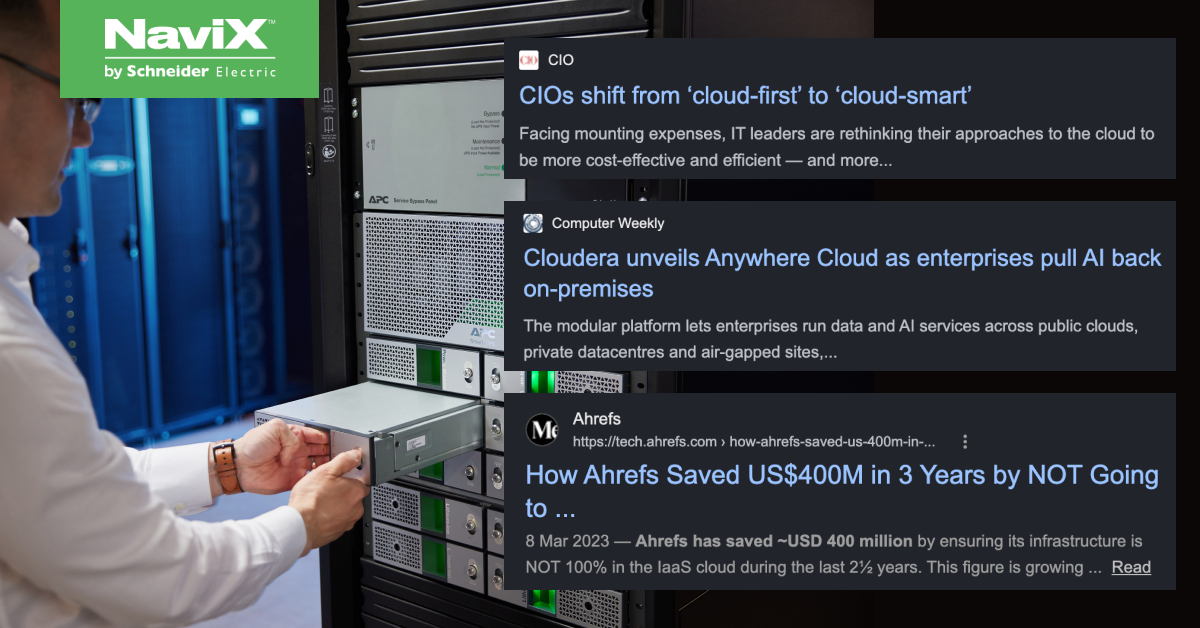
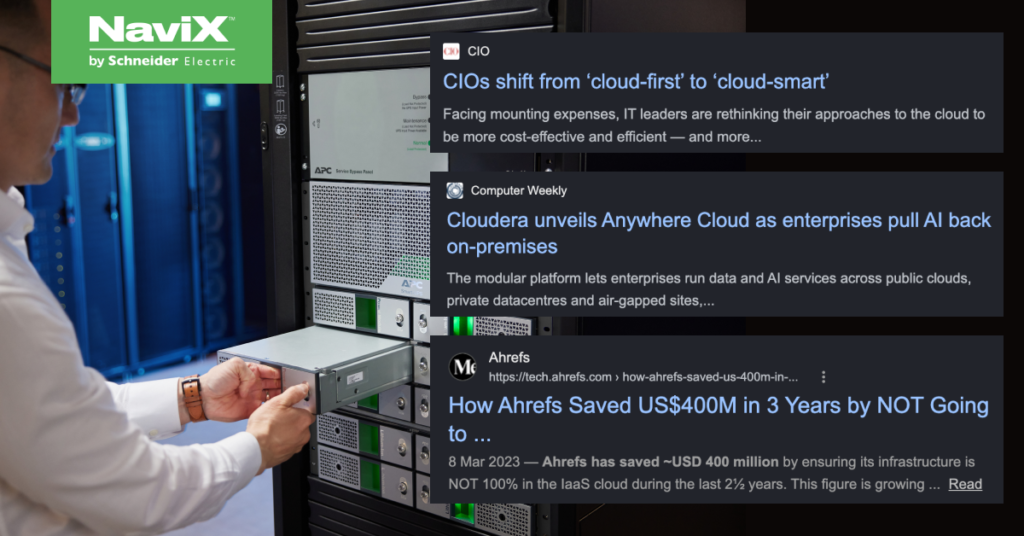
Cloud repatriation is back on the CIO’s agenda.

Forrester’s Cloud Survey found close to a third of public cloud-hosted applications are being repatriated — mostly workload by workload, not wholesale exits. IDC reports roughly 80% of enterprises expect to repatriate some compute or storage within a year, though only 8-9% plan a full exit. Gartner forecasts hybrid architectures will support mission-critical workflows at 40% of enterprises by end-2026, up from just 8% a few years ago — even as public cloud spend keeps growing past $720 billion globally.

Cost control, AI infrastructure demand, uptime, and disaster recovery are driving this shift. But here’s what most repatriation plans miss: bringing workloads home means bringing the power, cooling, and monitoring stack home too. That’s usually where the project stalls.

The Part of the Plan Nobody Budgets For

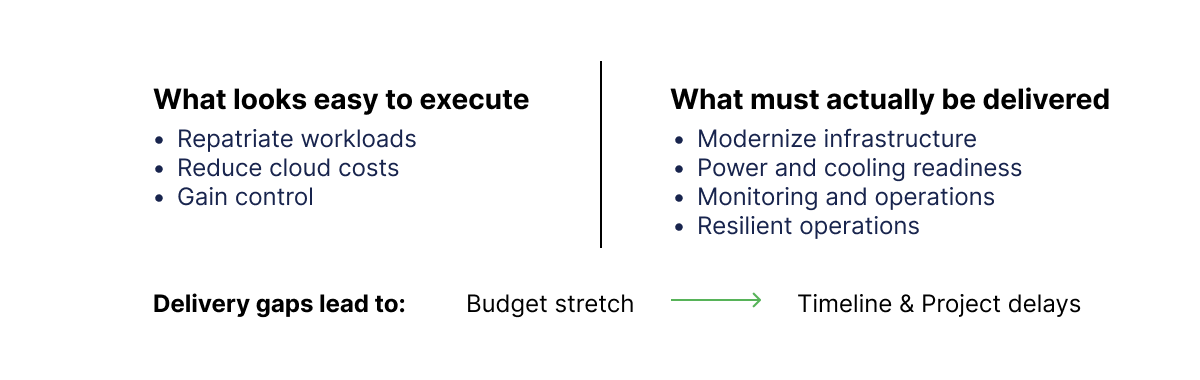
A repatriation business case is easy to build on compute alone. Move the workload, cut the cloud bill, gain control. What’s harder to model — and what derails timelines — is everything the workload depends on to actually run on-premise:

  • Power: redundant, conditioned, UPS-backed power sufficient for always-on enterprise and AI workloads. AI’s appetite here is no longer trivial
  • Cooling: thermal management sized for higher-density AI hardware, not legacy server rooms. Racks that used to run at 10–20kW are increasingly being pushed toward 100kW and beyond, with some analysts pointing to next-generation AI racks approaching 370kW — a jump that makes conventional air-cooled server rooms obsolete almost overnight.
  • Monitoring: real-time visibility into uptime, capacity, and failure risk — the operational nervous system that cloud providers used to handle invisibly. This isn’t a nice-to-have: the Uptime Institute’s 2025 Global Data Center Survey found organisations now average 2.3 significant outages a year, and the median outage lasted 53 minutes — long enough to matter at enterprise cost-of-downtime rates.

None of this is a compute problem. It’s a critical infrastructure problem. And it’s exactly the layer that CIOs focus on. 

This Is Where Repatriation Projects Delay

Setting up a server is not difficult. Designing N+1 redundant power, right-sizing cooling for GPU-dense racks, and building 24/7 monitoring with recovery protocols is a different conversation — one that turns a migration project into a CAPEX-heavy infrastructure build requiring specialist know-how most enterprises don’t keep in-house. Budgets stretch, timelines slip, and the business case that looked good on a spreadsheet stalls in committee.

This is why hybrid cloud — not full repatriation — has become the pragmatic default: enterprises want the control and cost benefits of on-premise infrastructure without re-acquiring the CAPEX and specialist capabilities they spent a decade shedding.

What Happens After the Move


Getting workloads home is only half the job. Once infrastructure is back on-premise, CIOs inherit ongoing maintenance, workflow redesign, manpower for round-the-clock fault response, and a wider web of vendors to manage — the hidden second wave that CIOs need to consider.

A playbook for CIOs

  1. Take the stress off your team’s plate. Power, cooling, and monitoring are specialist disciplines — carrying that load in-house on top of applications and workloads is how good IT teams get stretched thin.
  2. Eliminate the single point of failure. A repatriation done without redundant power and proper failover design just moves the risk from a cloud region to a server room. Resiliency has to be engineered in, not assumed.
  3. Get visibility the CIO can actually rely on. Real-time monitoring across on-premise and cloud means fewer surprises — and answers ready before the board asks the question.
  4. Build in resiliency from the start. AI-density workloads and always-on operations leave little room for reactive fixes. Design for uptime upfront rather than patching it in after an outage.
  5. Aim for operational excellence, not just uptime. The goal isn’t only “nothing broke” — it’s a hybrid environment that runs predictably, scales cleanly, and frees the IT/Ops lead to focus on higher-value work instead of firefighting.

Closing the Gap

For CIOs building a hybrid cloud strategy amid rising AI adoption, the real playbook isn’t cloud versus on-premise. It’s finding a partner who can deliver the full stack — compute, power, cooling, and visibility — so the capabilities gap never gets a chance to stall the project.


NaviX Solutions provides zero-CAPEX, subscription-based critical power and cooling solutions for Singapore’s enterprises and commercial building operators

You may like:

Navigating Singapore’s DC Scarcity: From Crowded Colos to In-House Strains Singapore’s data centre market has never been busier — or harder to …

How a consumer electronics manufacturing plant optimize their server room for efficiency and growth Explore Enterprise DC as a Service Learn more: …

The CIO’s playbook for hybrid cloud amid rising AI adoption

Cloud repatriation is back on the CIO’s agenda.

Forrester’s Cloud Survey found close to a third of public cloud-hosted applications are being repatriated — mostly workload by workload, not wholesale exits. IDC reports roughly 80% of enterprises expect to repatriate some compute or storage within a year, though only 8-9% plan a full exit. Gartner forecasts hybrid architectures will support mission-critical workflows at 40% of enterprises by end-2026, up from just 8% a few years ago — even as public cloud spend keeps growing past $720 billion globally.

Cost control, AI infrastructure demand, uptime, and disaster recovery are driving this shift. But here’s what most repatriation plans miss: bringing workloads home means bringing the power, cooling, and monitoring stack home too. That’s usually where the project stalls.

The Part of the Plan Nobody Budgets For


A repatriation business case is easy to build on compute alone. Move the workload, cut the cloud bill, gain control. What’s harder to model — and what derails timelines — is everything the workload depends on to actually run on-premise:

  • Power: redundant, conditioned, UPS-backed power sufficient for always-on enterprise and AI workloads. AI’s appetite here is no longer trivial
  • Cooling: thermal management sized for higher-density AI hardware, not legacy server rooms. Racks that used to run at 10–20kW are increasingly being pushed toward 100kW and beyond, with some analysts pointing to next-generation AI racks approaching 370kW — a jump that makes conventional air-cooled server rooms obsolete almost overnight.
  • Monitoring: real-time visibility into uptime, capacity, and failure risk — the operational nervous system that cloud providers used to handle invisibly. This isn’t a nice-to-have: the Uptime Institute’s 2025 Global Data Center Survey found organisations now average 2.3 significant outages a year, and the median outage lasted 53 minutes — long enough to matter at enterprise cost-of-downtime rates.

None of this is a compute problem. It’s a critical infrastructure problem. And it’s exactly the layer that CIOs focus on. 

This Is Where Repatriation Projects Delay


Setting up a server is not difficult. Designing N+1 redundant power, right-sizing cooling for GPU-dense racks, and building 24/7 monitoring with recovery protocols is a different conversation — one that turns a migration project into a CAPEX-heavy infrastructure build requiring specialist know-how most enterprises don’t keep in-house. Budgets stretch, timelines slip, and the business case that looked good on a spreadsheet stalls in committee.

This is why hybrid cloud — not full repatriation — has become the pragmatic default: enterprises want the control and cost benefits of on-premise infrastructure without re-acquiring the CAPEX and specialist capabilities they spent a decade shedding.

What Happens After the Move


Getting workloads home is only half the job. Once infrastructure is back on-premise, CIOs inherit ongoing maintenance, workflow redesign, manpower for round-the-clock fault response, and a wider web of vendors to manage — the hidden second wave that CIOs need to consider.

A playbook for CIOs

  1. Take the stress off your team’s plate. Power, cooling, and monitoring are specialist disciplines — carrying that load in-house on top of applications and workloads is how good IT teams get stretched thin.
  2. Eliminate the single point of failure. A repatriation done without redundant power and proper failover design just moves the risk from a cloud region to a server room. Resiliency has to be engineered in, not assumed.
  3. Get visibility the CIO can actually rely on. Real-time monitoring across on-premise and cloud means fewer surprises — and answers ready before the board asks the question.
  4. Build in resiliency from the start. AI-density workloads and always-on operations leave little room for reactive fixes. Design for uptime upfront rather than patching it in after an outage.
  5. Aim for operational excellence, not just uptime. The goal isn’t only “nothing broke” — it’s a hybrid environment that runs predictably, scales cleanly, and frees the IT/Ops lead to focus on higher-value work instead of firefighting.

Closing the Gap


For CIOs building a hybrid cloud strategy amid rising AI adoption, the real playbook isn’t cloud versus on-premise. It’s finding a partner who can deliver the full stack — compute, power, cooling, and visibility — so the capabilities gap never gets a chance to stall the project.


NaviX Solutions provides zero-CAPEX, subscription-based critical power and cooling solutions for Singapore’s enterprises and commercial building operators

Learn more:

Enterprise DC as-a-Service
Critical IT Power as-a-Service
Critical IT Cooling as a Service
UPS Trade-In Program

CIO’s Playbook for Hybrid Cloud Amid Rising AI Adoption Read More »

Low-hanging fruits for Singapore’s Mandatory Energy Improvement_MEI_compliance

Low-Hanging Fruits for Singapore’s Mandatory Energy Improvement (MEI) Compliance

Blog

Low-Hanging Fruits for Singapore’s Mandatory Energy Improvement (MEI) Compliance

What Building Owners Can Do Now

Singapore’s new Mandatory Energy Improvement (MEI) Regime marks a pivotal step forward in the nation’s decarbonisation journey. For the first time, energy efficiency isn’t just encouraged — it’s required.

Under the MEI regime, owners of energy-intensive buildings need to appoint a qualified professional mechanical engineer or registered energy auditor to carry out an energy audit and develop an Energy Efficiency Improvement Plan (EEIP) to reduce the building’s energy use intensity (EUI) by at least 10% from pre-audit levels.

For building owners and facility managers, this raises an important question: How can we achieve compliance efficiently — without heavy capital expenditure or operational disruption?

The answer lies in targeting low-hanging fruits: simple, cost-effective measures that can deliver real energy savings and measurable performance improvements right away.

Why Start with “Low-Hanging Fruits”?

When the Building and Construction Authority (BCA) identifies a building as “energy-intensive”, the building owner will be required to conduct an energy audit and implement efficiency measures within three years.

That sounds like a long runway — but those who act early stand to benefit the most.

  • They gain control of their data and energy profile before audits begin.
  • They can implement improvements gradually without disrupting operations.
  • And they’re more likely to unlock quick savings long before regulatory deadlines.

In our experience, even small operational changes can deliver 5–15% energy savings with minimal cost. Starting small also builds internal momentum — helping organisations shift from reactive compliance to proactive sustainability management.

1. Optimise Your HVAC Systems

HVAC systems often account for 40–60% of a building’s total energy consumption. Even minor inefficiencies — such as incorrect setpoints, poor chiller sequencing, or sensor faults — can significantly increase energy use.

Quick wins:

  • Recalibrate chilled water systems.
  • Check for faulty valves and sensors.
  • Adjust set points based on occupancy data.

Why it matters:
Optimising HVAC performance can yield a 5–10% immediate energy reduction, often without requiring equipment replacement. Continuous monitoring tools help sustain this improvement over time.

2. Fix What’s Broken (Even the Small Stuff)

Energy waste often comes from hidden issues: lights left on, malfunctioning dampers and many others. Implementing a fault detection and diagnostics (FDD) process can quickly identify and correct such inefficiencies.

Quick wins:

  • Replace faulty sensors.
  • Integrate alarms or alerts for abnormal energy use patterns.
  • Review equipment scheduling with actual operating use.

3. Upgrade Lighting System

Lighting retrofits are still one of the fastest ways to reduce energy use. Switching to LED lighting, paired with occupancy and daylight sensors, can cut lighting energy use by 30–50%.

Quick wins: 

  • Swap out conventional fittings for LEDs.
  • Introduce motion or daylight sensors.
  • Implement zone-based controls in low-traffic areas.
  • Prioritise high traffic zones first, then expand building wide.
  • Combine upgrades with smart control for better demand management.

4. Engage Occupants and Operations Team

Sometimes the biggest changes come from people, not systems. Small operational changes, when consistently applied, compound into measurable energy gains.

Quick wins:

  • Set clear internal energy goals.
  • Provide a real-time dashboard to the facilities team for visualisation of energy consumption.
  • Schedule cooling or lighting systems according to occupancy trends.

Sustained engagement builds a culture of efficiency — essential for meeting and maintaining MEI targets.

5. Keep It Continuous — Don’t “Set and Forget”

The MEI regime doesn’t just ask for improvement; it requires sustained performance over time (at least one year). That means once your building achieves its target EUI reduction, it must maintain that performance.

This makes continuous monitoring essential for compliance verification and early fault detection.

Potential benefits of continuous monitoring:

  • Tracks energy consumption trends in real time.
  • Supports audit documentation with verified data.
  • Detects performance drift before it affects compliance status.
  • Digital platforms that integrate with existing Building Management Systems (BMS) make this process seamless and data-driven.

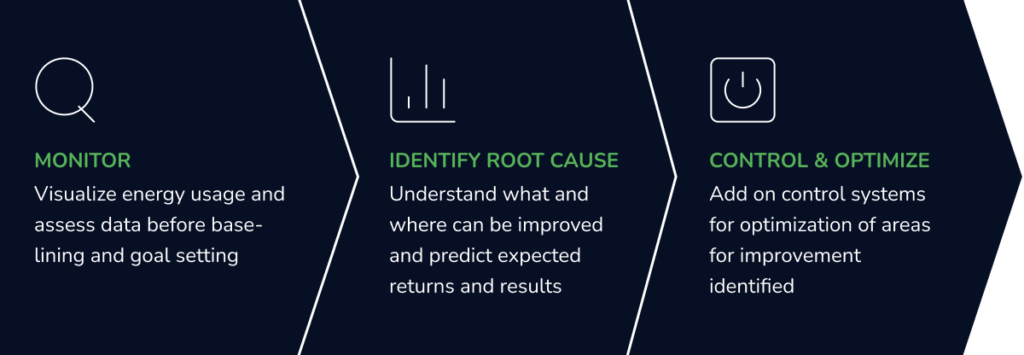
Monitoring is only the first step. Understanding how much electricity your building consumes provides the baseline needed for MEI readiness. But data alone doesn’t reduce energy use.

The next step is to identify the root causes behind high consumption patterns, evaluate which improvements offer the strongest returns. The real impact begins after monitoring, through optimisation. Deploying intelligent control systems like the Schneider Electric’s EcoStruxure Building Activate, enhancing automation, and tightening equipment scheduling turn raw data into measurable reduction — helping buildings progress from understanding the problem to actively solving it.

Beyond Compliance: Your Roadmap to EUI Reduction

The MEI Regime is not just a compliance requirement — it’s a turning point for how Singapore’s building owners view energy performance.

At NaviX Solutions, we understood that MEI compliance doesn’t always start with major investments. It starts with insight. Understanding your building’s performance today is the fastest route to long-term energy efficiency tomorrow. By focusing on data transparency, smart operations, and continuous optimisation, buildings can stay compliant and achieve long-term cost savings. The key is to start now, with the data and quick wins already within reach.

With the right data, smart solutions, and a partner like NaviX Solutions, you can start achieving results today — with zero upfront investment required.

Choose your low-hanging fruit. Start today.

Talk to us to find out how we can help you on your sustainability journey.

Low-Hanging Fruits for Singapore’s Mandatory Energy Improvement (MEI) Compliance

What Building Owners Can Do Now

Singapore’s new Mandatory Energy Improvement (MEI) Regime marks a pivotal step forward in the nation’s decarbonisation journey. For the first time, energy efficiency isn’t just encouraged — it’s required.

Under the MEI regime, owners of energy-intensive buildings need to appoint a qualified professional mechanical engineer or registered energy auditor to carry out an energy audit and develop an Energy Efficiency Improvement Plan (EEIP) to reduce the building’s energy use intensity (EUI) by at least 10% from pre-audit levels.

For building owners and facility managers, this raises an important question: How can we achieve compliance efficiently — without heavy capital expenditure or operational disruption?

The answer lies in targeting low-hanging fruits: simple, cost-effective measures that can deliver real energy savings and measurable performance improvements right away.

Why Start with “Low-Hanging Fruits”?

When the Building and Construction Authority (BCA) identifies a building as “energy-intensive”, the building owner will be required to conduct an energy audit and implement efficiency measures within three years.

That sounds like a long runway — but those who act early stand to benefit the most.

  • They gain control of their data and energy profile before audits begin.
  • They can implement improvements gradually without disrupting operations.
  • And they’re more likely to unlock quick savings long before regulatory deadlines.

In our experience, even small operational changes can deliver 5–15% energy savings with minimal cost. Starting small also builds internal momentum — helping organisations shift from reactive compliance to proactive sustainability management.

1. Optimise Your HVAC Systems

HVAC systems often account for 40–60% of a building’s total energy consumption. Even minor inefficiencies — such as incorrect setpoints, poor chiller sequencing, or sensor faults — can significantly increase energy use.

Quick wins:

  • Recalibrate chilled water systems.
  • Check for faulty valves and sensors.
  • Adjust set points based on occupancy data.

Why it matters:
Optimising HVAC performance can yield a 5–10% immediate energy reduction, often without requiring equipment replacement. Continuous monitoring tools help sustain this improvement over time.

2. Fix What’s Broken (Even the Small Stuff)

Energy waste often comes from hidden issues: lights left on, malfunctioning dampers and many others. Implementing a fault detection and diagnostics (FDD) process can quickly identify and correct such inefficiencies.

Quick wins:

  • Replace faulty sensors.
  • Integrate alarms or alerts for abnormal energy use patterns.
  • Review equipment scheduling with actual operating use.

3. Upgrade Lighting System

Lighting retrofits are still one of the fastest ways to reduce energy use. Switching to LED lighting, paired with occupancy and daylight sensors, can cut lighting energy use by 30–50%.

Quick wins: 

  • Swap out conventional fittings for LEDs.
  • Introduce motion or daylight sensors.
  • Implement zone-based controls in low-traffic areas.
  • Prioritise high traffic zones first, then expand building wide.
  • Combine upgrades with smart control for better demand management.

4. Engage Occupants and Operations Team

Sometimes the biggest changes come from people, not systems. Small operational changes, when consistently applied, compound into measurable energy gains.

Quick wins:

  • Set clear internal energy goals.
  • Provide a real-time dashboard to the facilities team for visualisation of energy consumption.
  • Schedule cooling or lighting systems according to occupancy trends.

Sustained engagement builds a culture of efficiency — essential for meeting and maintaining MEI targets.

5. Keep It Continuous — Don’t “Set and Forget”

The MEI regime doesn’t just ask for improvement; it requires sustained performance over time (at least one year). That means once your building achieves its target EUI reduction, it must maintain that performance.

This makes continuous monitoring essential for compliance verification and early fault detection.

Potential benefits of continuous monitoring:

  • Tracks energy consumption trends in real time.
  • Supports audit documentation with verified data.
  • Detects performance drift before it affects compliance status.
  • Digital platforms that integrate with existing Building Management Systems (BMS) make this process seamless and data-driven.

Monitoring is only the first step. Understanding how much electricity your building consumes provides the baseline needed for MEI readiness. But data alone doesn’t reduce energy use.

The next step is to identify the root causes behind high consumption patterns, evaluate which improvements offer the strongest returns. The real impact begins after monitoring, through optimisation. Deploying intelligent control systems like the Schneider Electric’s EcoStruxure Building Activate, enhancing automation, and tightening equipment scheduling turn raw data into measurable reduction — helping buildings progress from understanding the problem to actively solving it.

Beyond Compliance: Your Roadmap to EUI Reduction

The MEI Regime is not just a compliance requirement — it’s a turning point for how Singapore’s building owners view energy performance.

At NaviX Solutions, we understood that MEI compliance doesn’t always start with major investments. It starts with insight. Understanding your building’s performance today is the fastest route to long-term energy efficiency tomorrow. By focusing on data transparency, smart operations, and continuous optimisation, buildings can stay compliant and achieve long-term cost savings. The key is to start now, with the data and quick wins already within reach.

With the right data, smart solutions, and a partner like NaviX Solutions, you can start achieving results today — with zero upfront investment required.

Choose your low-hanging fruit. Start today.

Talk to us to find out how we can help you on your sustainability journey.

Low-Hanging Fruits for Singapore’s Mandatory Energy Improvement (MEI) Compliance Read More »

Driving the future with EV Charger and Microgrid

Driving the future: How incentives and microgrid infrastructure will shape Singapore’s heavy vehicles electrification transition

Blog

Driving the future: How incentives and microgrid infrastructure will shape Singapore’s heavy vehicles electrification transition

Incentives may lower upfront costs, but resilient charging and power systems will define long-term success. The businesses that prepare early will lead the next era of sustainable logistics.

Singapore has taken bold and steady steps in its journey towards net-zero by 2050. While passenger electric vehicles (EVs) have seen steady uptake, heavy vehicles such as cargo trucks, buses, and prime mover, present more complex challenges. These heavy vehicles are more expensive, require fast and reliable charging, and demand significant electrical capacity at depots and premises.

To bridge these barriers, the government has announced a suite of incentives for electric heavy vehicles (EHVs), starting from 2026. These initiatives are designed to close the cost gap with diesel, catalyse adoption, and future-proof the nation’s transport infrastructure.

Heavy Vehicle Zero Emissions Scheme (HVZES)

From 1 January 2026 to 31 December 2028, fleet operators can receive up to S$40,000 per electric heavy vehicle. The incentive is disbursed in tranches—S$13,000 at registration, another S$13,000 after one year, and the remaining S$14,000 after two years.

This support make some of the EV trucks in the market nearly cost-competitive with diesel, significantly lowering the financial hurdle for early adopters.
> View Grant

Electric Heavy Vehicle Charger Grant (EHVCG)

Charging infrastructure is another key focus. Under the EHVCG, businesses can receive 50% co-funding for charger installation costs, capped at S$30,000 per charger. The scheme covers the first 500 chargers nationwide, with a limit of three chargers per site, and applies to fast chargers (≥ 50 kW) installed at designated lorry or coach lots.

This programme ensures that early adopters of EHVs have access to the backbone infrastructure needed to keep operations running smoothly.

Industry Perspectives and Adoption Hurdles

While the schemes have been welcomed, several realities have been pointed out:

  • Deferred demand in 2025: Some businesses may delay purchases until incentives kick in.
  • Charger installation still costly: Electrical upgrades, grid connection fees, and high-voltage wiring add to deployment costs. In this case, businesses may look for alternatives like EV Charger as a Service to reduce the upfront capital investment needed.

Despite these challenges, the incentives are expected to spark momentum. Over time, increased demand should bring in more vehicle models, encourage global suppliers to participate, and reduce lifecycle costs.


Is Your Building/Site Ready for EV Fleets?

For businesses, purchasing electric trucks and installing fast EV chargers is only half the journey. The real test lies in whether their buildings and depots can supply the power needed for charging.

  • Load capacity constraints: Many buildings, warehouses and industrial sites were never designed for fast chargers, which can draw huge amount of energy, significantly increasing the peak load demand, potentially causing issues for the electrical grid. 
  • High cost of grid upgrades: Strengthening electrical connections often requires significant investment and coordination with utilities.
  • Operational risks: Without reliable charging, even a well-planned fleet conversion could disrupt logistics.

This “hidden bottleneck” is a critical consideration for any fleet operator.

At NaviX Solutions, we believe in addressing this challenge head-on. Our expertise lies in:

  • Load assessments to evaluate site readiness.
  • Deploying Battery Energy Storage Systems (BESS) to manage peak demand and reduce reliance on costly grid upgrades.
  • Building microgrids and smart energy systems that integrate solar, storage, and EV charging for long-term resilience.
  • Offering a zero-upfront subscription-based model to ease the capital burden for businesses transitioning to zero-emissions fleets.

By ensuring power availability, we help businesses unlock a truly sustainable and operationally secure electrification strategy.

Looking Ahead

Singapore’s heavy vehicle incentives are more than subsidies—they are signals of where the future is heading. By 2026, fleet operators will face a transformed landscape where electrification is no longer optional but inevitable.

Those who prepare early, ensuring both their vehicles and premises are electrification-ready, will gain the dual advantage of government support and operational resilience.

At NaviX Solutions, we see ourselves not just as technology providers, but as partners in building that future—helping businesses overcome infrastructure challenges, optimise energy use, and embrace sustainability as a driver of long-term growth.

Driving the future: How incentives and microgrid infrastructure will shape Singapore’s heavy vehicles electrification transition

Incentives may lower upfront costs, but resilient charging and power systems will define long-term success. The businesses that prepare early will lead the next era of sustainable logistics.

Singapore has taken bold and steady steps in its journey towards net-zero by 2050. While passenger electric vehicles (EVs) have seen steady uptake, heavy vehicles such as cargo trucks, buses, and prime mover, present more complex challenges. These heavy vehicles are more expensive, require fast and reliable charging, and demand significant electrical capacity at depots and premises.

To bridge these barriers, the government has announced a suite of incentives for electric heavy vehicles (EHVs), starting from 2026. These initiatives are designed to close the cost gap with diesel, catalyse adoption, and future-proof the nation’s transport infrastructure.

Heavy Vehicle Zero Emissions Scheme (HVZES)

From 1 January 2026 to 31 December 2028, fleet operators can receive up to S$40,000 per electric heavy vehicle. The incentive is disbursed in tranches—S$13,000 at registration, another S$13,000 after one year, and the remaining S$14,000 after two years.

This support make some of the EV trucks in the market nearly cost-competitive with diesel, significantly lowering the financial hurdle for early adopters.
> View Grant

Electric Heavy Vehicle Charger Grant (EHVCG)

Charging infrastructure is another key focus. Under the EHVCG, businesses can receive 50% co-funding for charger installation costs, capped at S$30,000 per charger. The scheme covers the first 500 chargers nationwide, with a limit of three chargers per site, and applies to fast chargers (≥ 50 kW) installed at designated lorry or coach lots.

This programme ensures that early adopters of EHVs have access to the backbone infrastructure needed to keep operations running smoothly.

Industry Perspectives and Adoption Hurdles

While the schemes have been welcomed, several realities have been pointed out:

  • Deferred demand in 2025: Some businesses may delay purchases until incentives kick in.
  • Charger installation still costly: Electrical upgrades, grid connection fees, and high-voltage wiring add to deployment costs. In this case, businesses may look for alternatives like EV Charger as a Service to reduce the upfront capital investment needed.

Despite these challenges, the incentives are expected to spark momentum. Over time, increased demand should bring in more vehicle models, encourage global suppliers to participate, and reduce lifecycle costs.Incentives may lower upfront costs, but resilient charging and power systems will define long-term success. The businesses that prepare early will lead the next era of sustainable logistics.

Singapore has taken bold and steady steps in its journey towards net-zero by 2050. While passenger electric vehicles (EVs) have seen steady uptake, heavy vehicles such as cargo trucks, buses, and prime mover, present more complex challenges. These heavy vehicles are more expensive, require fast and reliable charging, and demand significant electrical capacity at depots and premises.

To bridge these barriers, the government has announced a suite of incentives for electric heavy vehicles (EHVs), starting from 2026. These initiatives are designed to close the cost gap with diesel, catalyse adoption, and future-proof the nation’s transport infrastructure.

Heavy Vehicle Zero Emissions Scheme (HVZES)

From 1 January 2026 to 31 December 2028, fleet operators can receive up to S$40,000 per electric heavy vehicle. The incentive is disbursed in tranches—S$13,000 at registration, another S$13,000 after one year, and the remaining S$14,000 after two years.

This support make some of the EV trucks in the market nearly cost-competitive with diesel, significantly lowering the financial hurdle for early adopters.
> View Grant

Electric Heavy Vehicle Charger Grant (EHVCG)

Charging infrastructure is another key focus. Under the EHVCG, businesses can receive 50% co-funding for charger installation costs, capped at S$30,000 per charger. The scheme covers the first 500 chargers nationwide, with a limit of three chargers per site, and applies to fast chargers (≥ 50 kW) installed at designated lorry or coach lots.

This programme ensures that early adopters of EHVs have access to the backbone infrastructure needed to keep operations running smoothly.

Industry Perspectives and Adoption Hurdles

While the schemes have been welcomed, several realities have been pointed out:

  • Deferred demand in 2025: Some businesses may delay purchases until incentives kick in.
  • Charger installation still costly: Electrical upgrades, grid connection fees, and high-voltage wiring add to deployment costs. In this case, businesses may look for alternatives like EV Charger as a Service to reduce the upfront capital investment needed.

Despite these challenges, the incentives are expected to spark momentum. Over time, increased demand should bring in more vehicle models, encourage global suppliers to participate, and reduce lifecycle costs.
Is Your Building/Site Ready for EV Fleets?

For businesses, purchasing electric trucks and installing fast EV chargers is only half the journey. The real test lies in whether their buildings and depots can supply the power needed for charging.

  • Load capacity constraints: Many buildings, warehouses and industrial sites were never designed for fast chargers, which can draw huge amount of energy, significantly increasing the peak load demand, potentially causing issues for the electrical grid. 
  • High cost of grid upgrades: Strengthening electrical connections often requires significant investment and coordination with utilities.
  • Operational risks: Without reliable charging, even a well-planned fleet conversion could disrupt logistics.

This “hidden bottleneck” is a critical consideration for any fleet operator.

At NaviX Solutions, we believe in addressing this challenge head-on. Our expertise lies in:

  • Load assessments to evaluate site readiness.
  • Deploying Battery Energy Storage Systems (BESS) to manage peak demand and reduce reliance on costly grid upgrades.
  • Building microgrids and smart energy systems that integrate solar, storage, and EV charging for long-term resilience.
  • Offering a zero-upfront subscription-based model to ease the capital burden for businesses transitioning to zero-emissions fleets.

By ensuring power availability, we help businesses unlock a truly sustainable and operationally secure electrification strategy.

Looking Ahead

Singapore’s heavy vehicle incentives are more than subsidies—they are signals of where the future is heading. By 2026, fleet operators will face a transformed landscape where electrification is no longer optional but inevitable.

Those who prepare early, ensuring both their vehicles and premises are electrification-ready, will gain the dual advantage of government support and operational resilience.

At NaviX Solutions, we see ourselves not just as technology providers, but as partners in building that future—helping businesses overcome infrastructure challenges, optimise energy use, and embrace sustainability as a driver of long-term growth.

Driving the future: How incentives and microgrid infrastructure will shape Singapore’s heavy vehicles electrification transition Read More »

Maximising guest comfort and energy savings Singapore (1)

Enhancing Guest Room Comfort & Energy Savings with Connected Room Solutions

Blog

Enhancing Guest Room Comfort & Energy Savings with Connected Room Solutions

In today’s competitive hospitality landscape, you face the challenge of creating exceptional guest experiences while maintaining operational efficiency. You need to strike the right balance between delivering comfort and managing energy costs. That’s why you can rely on solutions that help you achieve both—like the SpaceLogic™ TC907 and SE8350 Room Controllers from Schneider Electric.

Smarter Rooms, Happier Guests

GRMS Subscription Blogpost

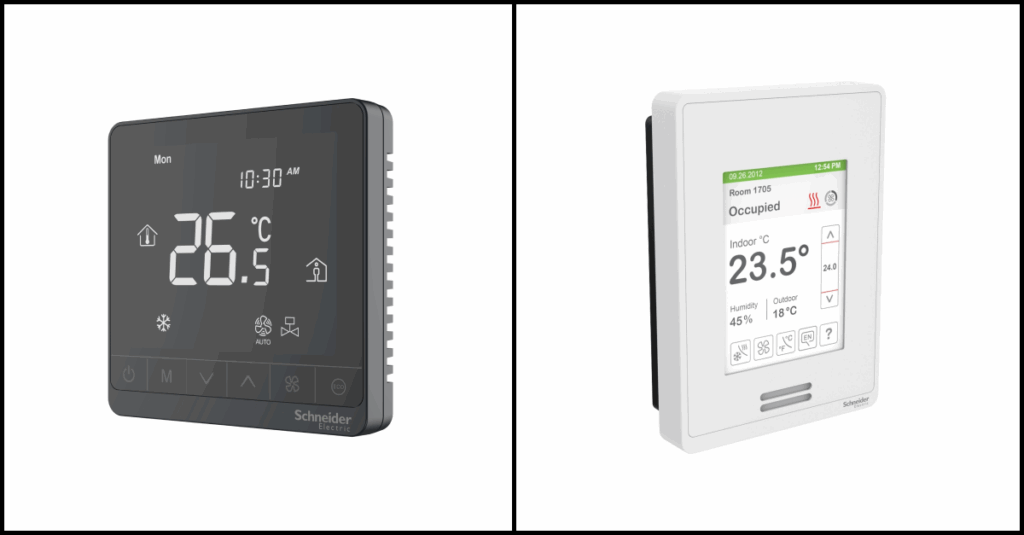
From left: SpaceLogic TC907, SpaceLogic SE8350

Guests expect comfort, simplicity, and personalization during their stay. The SpaceLogic TC907 delivers just that. These smart fan coil thermostats are designed and optimised specifically for hotel rooms, offering intuitive touch interfaces, eco-button for energy saving & real-time display. TC907 offers a straightforward & easy control for the guest—and savings for your property.

Meanwhile, the SpaceLogic™ SE8350 Room Controller goes even further. With its built-in temperature, humidity, and occupancy sensing, it provides a complete room automation solution. The SE8350 supports integration with lighting, blinds, and even door/window sensors, giving hotels full control of the room environment and energy usage. It’s sleek, modern, and customizable—perfect for brands that want technology to match their aesthetic.

Why It Matters: Comfort Meets ROI

These devices don’t just enhance the guest experience—they’re also a smart business decision. Hotels using the TC907 or SE8350 have reported up to 30% energy savings, all while improving guest satisfaction scores. Thanks to advanced scheduling, automatic setback modes, and data-driven insights, hotel operators can quickly see a return on investment.

Whether you’re retrofitting an older property or designing a new build, smart room controllers make it easy to align sustainability goals with superior service.

One Subscription, Complete Control

To make it even easier to implement these solutions, Navix Solutions offers a standardised Guest Room Management System Subscription Plan. We bundle hardware, software, and ongoing support into one simple monthly cost. We handle the installation, integration, and maintenance—so you can keep your focus on your guests.

Simply choose between Basic Service Plan and/or Limited Service Plan

Ready to Elevate Your Guest Experience?

Don’t let energy waste or outdated thermostats stand in the way of modern guest expectations.

Get in touch with us today to discover more about our Guest Room Management System Subscription Plan. Find out how Schneider Electric’s smart thermostats and room controllers can help future-proof your hotel, improve your energy savings and elevate your guests’ experience.

Enhancing Guest Room Comfort & Energy Savings with Connected Room Solutions

In today’s competitive hospitality landscape, you face the challenge of creating exceptional guest experiences while maintaining operational efficiency. You need to strike the right balance between delivering comfort and managing energy costs. That’s why you can rely on solutions that help you achieve both—like the SpaceLogic™ TC907 and SE8350 Room Controllers from Schneider Electric.

Smarter Rooms, Happier Guests

From left: SpaceLogic TC907, SpaceLogic SE8350

Guests expect comfort, simplicity, and personalization during their stay. The SpaceLogic TC907 delivers just that. These smart fan coil thermostats are designed and optimised specifically for hotel rooms, offering intuitive touch interfaces, eco-button for energy saving & real-time display. TC907 offers a straightforward & easy control for the guest—and savings for your property.

Meanwhile, the SpaceLogic™ SE8350 Room Controller goes even further. With its built-in temperature, humidity, and occupancy sensing, it provides a complete room automation solution. The SE8350 supports integration with lighting, blinds, and even door/window sensors, giving hotels full control of the room environment and energy usage. It’s sleek, modern, and customizable—perfect for brands that want technology to match their aesthetic.

Why It Matters: Comfort Meets ROI

These devices don’t just enhance the guest experience—they’re also a smart business decision. Hotels using the TC907 or SE8350 have reported up to 30% energy savings, all while improving guest satisfaction scores. Thanks to advanced scheduling, automatic setback modes, and data-driven insights, hotel operators can quickly see a return on investment.

Whether you’re retrofitting an older property or designing a new build, smart room controllers make it easy to align sustainability goals with superior service.

One Subscription, Complete Control

To make it even easier to implement these solutions, Navix Solutions offers a standardised Guest Room Management System Subscription Plan. We bundle hardware, software, and ongoing support into one simple monthly cost. We handle the installation, integration, and maintenance—so you can keep your focus on your guests.

Simply choose between Basic Service Plan and/or Limited Service Plan

Ready to Elevate Your Guest Experience?

Don’t let energy waste or outdated thermostats stand in the way of modern guest expectations.

Get in touch with us today to discover more about our Guest Room Management System Subscription Plan. Find out how Schneider Electric’s smart thermostats and room controllers can help future-proof your hotel, improve your energy savings and elevate your guests’ experience.

Enhancing Guest Room Comfort & Energy Savings with Connected Room Solutions Read More »

Navix Solutions Support Singapore’s National Team For Asia Muay Thai Championships 2025

Navix Solutions Support Singapore’s National Team For Asia Muay Thai Championships 2025

NaviX Solutions is thrilled to announce our official partnership with, and support for, the Singapore Muay Thai Association, for the upcoming Asia Muay Thai Championships 2025. As firm believers in discipline, agility, and the drive to push boundaries, we’re proud to stand behind our national athletes who embody these values both in and out of the ring.

From left: Wayne Low, Arjun, Terence Teo, Kenny Koh (NaviX), Ethan Tan (NaviX), Jeryl Khoo, Ginny Teo, Cheryl Gwa, Samantha Lee

Flexibility, Agility And Path To Excellence

Ethan Tan, Head of Marketing Communications, shared his thoughts on this exciting and meaningful partnership, “At NaviX, our OPEX business model provides packaged, managed services for infrastructure assets with zero upfront costs and fixed monthly expenses for mechanical & electrical infrastructure, mirrors the discipline and strategic planning required by Muay Thai athletes. Just as we enable our clients to focus on their core business and strengths, we support athletes in honing their skills and achieving excellence. Together, we’re championing the growth of Muay Thai in Singapore — supporting local talent, building community, and powering performance.”

About Asia Muay Thai Championships 2025

The Asia Muay Thai Championships 2025 is held in the northern province of Thai Nguyen, Vietnam. Co-organised by the Sports Authority of Vietnam under the Ministry of Culture, Sports and Tourism, and the provincial People’s Committee, the event runs from June 21 to 26. The tournament has gathered over 300 coaches, athletes, and referees from 18 countries and territories, competing in 28 combat weight categories and eight performance categories.

About Singapore MuayThai Association (SMA)

The Singapore MuayThai Association (SMA) is the official National Sports Association (NSA) for Muay Thai in Singapore, recognized for promoting, regulating, and growing the sport at all levels—from grassroots to international competition.

Established to unify the Muay Thai community under a single banner, SMA represents Singapore within the global Muay Thai movement under the auspices of the International Federation of Muaythai Associations (IFMA).

Navix Solutions Support Singapore’s National Team For Asia Muay Thai Championships 2025

NaviX Solutions is thrilled to announce our official partnership with, and support for, the Singapore Muay Thai Association, for the upcoming Asia Muay Thai Championships 2025. As firm believers in discipline, agility, and the drive to push boundaries, we’re proud to stand behind our national athletes who embody these values both in and out of the ring.

From left: Wayne Low, Arjun, Terence Teo, Kenny Koh (NaviX), Ethan Tan (NaviX), Jeryl Khoo, Ginny Teo, Cheryl Gwa, Samantha Lee

Flexibility, Agility And Path To Excellence

Ethan Tan, Head of Marketing Communications, shared his thoughts on this exciting and meaningful partnership, “At NaviX, our OPEX business model provides packaged, managed services for infrastructure assets with zero upfront costs and fixed monthly expenses for mechanical & electrical infrastructure, mirrors the discipline and strategic planning required by Muay Thai athletes. Just as we enable our clients to focus on their core business and strengths, we support athletes in honing their skills and achieving excellence. Together, we’re championing the growth of Muay Thai in Singapore — supporting local talent, building community, and powering performance.”

About Asia Muay Thai Championships 2025

The Asia Muay Thai Championships 2025 is held in the northern province of Thai Nguyen, Vietnam. Co-organised by the Sports Authority of Vietnam under the Ministry of Culture, Sports and Tourism, and the provincial People’s Committee, the event runs from June 21 to 26. The tournament has gathered over 300 coaches, athletes, and referees from 18 countries and territories, competing in 28 combat weight categories and eight performance categories.

About Singapore MuayThai Association (SMA)

The Singapore MuayThai Association (SMA) is the official National Sports Association (NSA) for Muay Thai in Singapore, recognized for promoting, regulating, and growing the sport at all levels—from grassroots to international competition.

Established to unify the Muay Thai community under a single banner, SMA represents Singapore within the global Muay Thai movement under the auspices of the International Federation of Muaythai Associations (IFMA).

Navix Solutions Support Singapore’s National Team For Asia Muay Thai Championships 2025 Read More »

NaviX Solutions Launches Schneider Electric Product-based Subscription Plans

Navix Solutions Launches Newly Enhanced Schneider Electric Product-based Subscription Plans to Deliver Greater Value for Clients

Navix Solutions Launches Newly Enhanced Schneider Electric Product-based Subscription Plans to Deliver Greater Value for Clients

Feb 17, 2025 – NaviX Solutions Pte Ltd (“NaviX”), a first-to-market provider of cleaner, greener and smarter Infrastructure-as-a-Service (“IaaS”), is proud to announce the official launch of its newly enhanced Schneider Electric product-based subscription plans for energy monitoring, EV charger, and uninterruptible power supply (UPS), designed to offer businesses more value, flexibility, and zero upfront-cost solutions to meet their evolving needs.

The updated initiative comes with refreshed pricing models and additional value-add options for clients, allowing them to customize their subscriptions to better suit their operational requirements. With these improvements, Navix Solutions aims to provide clients with even greater returns on their investments while ensuring reliability, scalability and improved operational efficiency for the long term.

Leong Wei Yang, Head of SPO at Navix Solutions, expressed enthusiasm, “We are excited to officially launch the Schneider Electric product-based subscription plans. This launch marks a significant milestone for Navix Solutions as we aim to provide our clients with greater value, financial agility and a hassle-free experience. With updated pricing models, new product variants and a range of new value-add options, we are giving our clients more for their investment.“

The subscription plans include:

These offerings are designed to provide businesses with the ability to easily manage their energy, transportation, and power needs through a subscription model that maximizes both flexibility and value, helping businesses grow sustainably while keeping costs under control.

“Over the past year, we have partnered closely with colleagues from Schneider Electric to refine and enhance our product offerings. This collaboration allowed us to integrate the latest energy management technologies, ensuring our solutions deliver superior performance and energy efficiency. By combining Schneider Electric’s leadership in sustainable energy solutions with our Infrastructure as-a-Service model, we have been able to create more seamless and scalable solutions that empowers businesses to reduce their environmental impact, optimize energy consumption, and lower operational costs. Our ongoing partnership remains integral as we continue to innovate and provide unparalleled value to our clients.” said Naween Kaluarachchi, Head of Commercial and Strategy at NaviX Solutions.

With the launch of the newly enhanced subscription plans, Navix Solutions reinforces its position as a trusted partner for organizations seeking innovative, scalable, and value-driven solutions in mechanical and electrical infrastructure investment, not limited to energy management, electric vehicle infrastructure, and power reliability.

About NaviX Solutions:

Headquartered in Singapore and jointly incubated by Schneider Electric and Singapore’s Economic Development Board, Navix Solutions Pte Ltd is a first-to-market provider of cleaner, greener and smarter Infrastructure-as-a-Service (“IaaS”), enabling decarbonisation and accelerating the energy transition.

For more information on NaviX Solutions, please visit www.navixsolutions.com

Media Contact
Ethan Tan
Head of Marketing Communications
NaviX Solutions Pte Ltd
Email: ethan.tan@navixsolutions.com

Navix Solutions Launches Newly Enhanced Schneider Electric Product-based Subscription Plans to Deliver Greater Value for Clients

Feb 17, 2025 – NaviX Solutions Pte Ltd (“NaviX”), a first-to-market provider of cleaner, greener and smarter Infrastructure-as-a-Service (“IaaS”), is proud to announce the official launch of its newly enhanced Schneider Electric product-based subscription plans for energy monitoringEV charger, and uninterruptible power supply (UPS), designed to offer businesses more value, flexibility, and zero upfront-cost solutions to meet their evolving needs.

The updated initiative comes with refreshed pricing models and additional value-add options for clients, allowing them to customize their subscriptions to better suit their operational requirements. With these improvements, Navix Solutions aims to provide clients with even greater returns on their investments while ensuring reliability, scalability and improved operational efficiency for the long term.

Leong Wei Yang, Head of SPO at Navix Solutions, expressed enthusiasm, “We are excited to officially launch the Schneider Electric product-based subscription plans. This launch marks a significant milestone for Navix Solutions as we aim to provide our clients with greater value, financial agility and a hassle-free experience. With updated pricing models, new product variants and a range of new value-add options, we are giving our clients more for their investment.“

The subscription plans include:

These offerings are designed to provide businesses with the ability to easily manage their energy, transportation, and power needs through a subscription model that maximizes both flexibility and value, helping businesses grow sustainably while keeping costs under control.

“Over the past year, we have partnered closely with colleagues from Schneider Electric to refine and enhance our product offerings. This collaboration allowed us to integrate the latest energy management technologies, ensuring our solutions deliver superior performance and energy efficiency. By combining Schneider Electric’s leadership in sustainable energy solutions with our Infrastructure as-a-Service model, we have been able to create more seamless and scalable solutions that empowers businesses to reduce their environmental impact, optimize energy consumption, and lower operational costs. Our ongoing partnership remains integral as we continue to innovate and provide unparalleled value to our clients.” said Naween Kaluarachchi, Head of Commercial and Strategy at NaviX Solutions.

With the launch of the newly enhanced subscription plans, Navix Solutions reinforces its position as a trusted partner for organizations seeking innovative, scalable, and value-driven solutions in mechanical and electrical infrastructure investment, not limited to energy management, electric vehicle infrastructure, and power reliability.

About NaviX Solutions:

Headquartered in Singapore and jointly incubated by Schneider Electric and Singapore’s Economic Development Board, Navix Solutions Pte Ltd is a first-to-market provider of cleaner, greener and smarter Infrastructure-as-a-Service (“IaaS”), enabling decarbonisation and accelerating the energy transition.

For more information on NaviX Solutions, please visit www.navixsolutions.com

Media Contact
Ethan Tan
Head of Marketing Communications
NaviX Solutions Pte Ltd
Email: ethan.tan@navixsolutions.com

Learn more:

Navix Solutions Launches Newly Enhanced Schneider Electric Product-based Subscription Plans to Deliver Greater Value for Clients Read More »

Navix Solutions Signs MoU to Deliver Comprehensive Smart Infrastructure Solutions in Vietnam

Navix Solutions Signs MoU to Deliver Comprehensive Smart Infrastructure Solutions in Vietnam

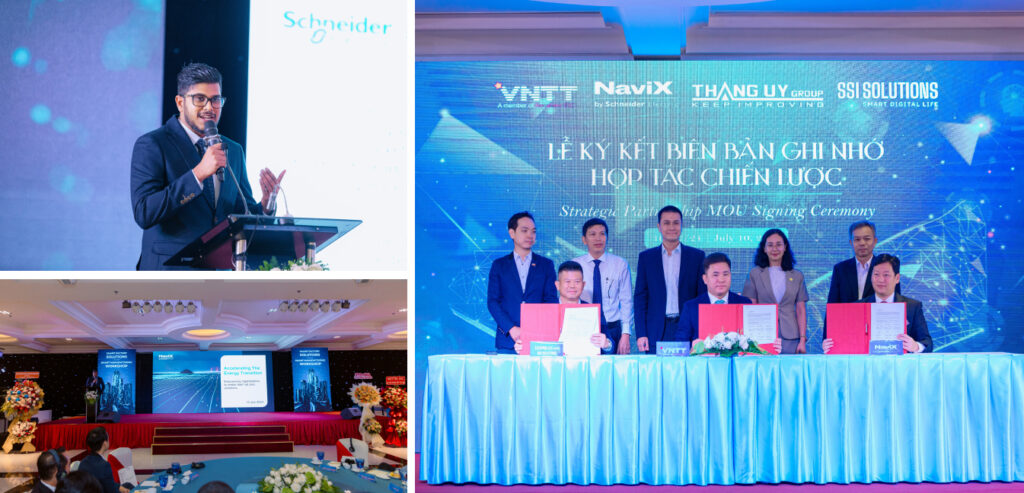
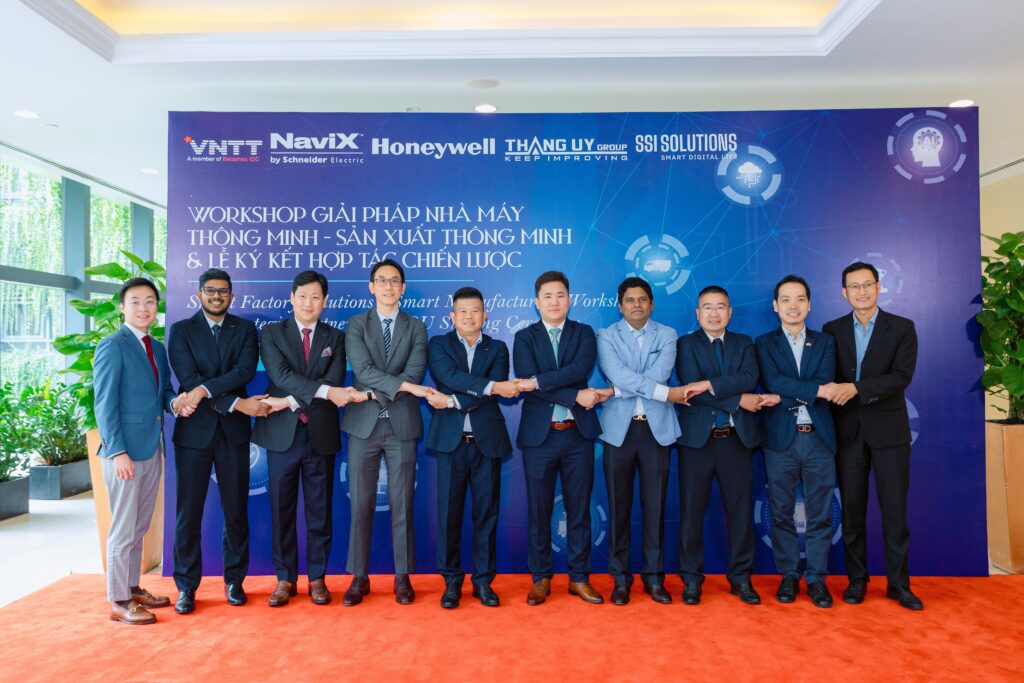
Singapore – July 19 2024 – Navix Solutions is excited to announce a strategic partnership formalized through a Memorandum of Understanding (MoU) with Thang Uy Group, SSI Solutions, VNTT, and Honeywell. This collaboration aims to introduce Smart Infrastructure solutions to aid factories and industrial parks in Vietnam in their journey towards smart and sustainable industrial development.

Representatives of NaviX Solutions, VNTT, Honeywell and SSI Solutions at the ceremony

The signing ceremony took place at the Becamex New City Hotel in Binh Duong, where industry leaders from the Department of Science and Technology, Department of Information and Communications, Department of Foreign Affairs of Binh Duong province; Representative of the United States Consulate in Ho Chi Minh City; Leadership representative of Becamex IDC Vietnam Corporation; gathered to explore advancements in smart factory and industrial park solutions. This ceremony underscores Navix Solutions’ commitment to leveraging cutting-edge technologies to enhance operational efficiency and sustainability in industrial settings.

Photos from the Strategic Partnership MOU Signing Ceremony event

“Partnering with industry leaders empowers us to drive digital transformation and sustainable growth across Vietnam’s industrial sector. This is also a significant step in NaviX’s growth and commitment to sustainability, bringing our expertise and solutions to the Vietnamese market and supporting businesses in transitioning towards more sustainable and energy efficient operations” said Peter Goh, CEO of NaviX Solutions. “Our joint efforts will help businesses achieve operational excellence and propel towards their Net-Zero goals.”

Naween Kaluarachchi, Head of Business Development of NaviX Solutions expressed enthusiasm about the partnership, stating, “We are extremely excited to expand our presence in Vietnam’s industrial sector through these strategic partnerships. We are confident that our end-to-end Infrastructure as-a-Service approach will empower Vietnamese businesses to overcome the technical and financial challenges of rapid market changes while balancing the need for sustainable transformation.

About NaviX Solutions:
Headquartered in Singapore and jointly incubated by Schneider Electric and Singapore’s Economic Development Board, Navix Solutions Pte Ltd is a first-to-market provider of cleaner, greener and smarter Infrastructure-as-a-Service (“IaaS”), enabling decarbonisation and accelerating the energy transition.

For more information on NaviX Solutions, please visit www.navixsolutions.com

About VNTT: 
Vietnam Technology and Communication Joint Stock Company (VNTT) is a company established with the capital contribution of two founding shareholders: Industrial Investment and Development Corporation (Becamex IDC ) , Vietnam Posts and Telecommunications Group ( VNPT ).

Being a unit that comprehensively and diversely meets the needs of Telecommunications – Information Technology ( ICT ); data center services with eDatacenter meeting TIA942/Tier 3 standards in terms of geographical location and availability reaching 99.982% ; MEP services for businesses in the Ho Chi Minh City, Binh Duong markets and in Industrial Parks invested by Becamex IDC across the country. VNTT has standardized the management process and service provision according to international standards, achieving ISO 9001:2015 and ISO 27001:2013 certification .

In the era of technology 4.0, VNTT has made bold steps to start the trend of shifting to the field of developing smart solutions, and currently VNTT is in the process of developing and deploying smart management solutions in industrial parks invested by Becamex across the country. Including: management software for the IOC Binh Duong Smart Operation Center, IOC Becamex; smart solutions such as: Smart public lighting system, Smart parking lot, Smart building management and smart wastewater plant.

About Thang Uy Group:
Established in 1999, it was formerly a distributor of industrial equipment of large manufacturing corporations in the world to serve the production needs of factories. Up to now, with 25 years of experience in the industry, Thang Uy Group has transformed itself from a Commercial Distributor to a Total and Comprehensive Solution Provider to a Manufacturer in the field of industrial equipment.

Thang Uy Group is currently not only a leading provider of industrial equipment solutions in the Vietnamese market but also a leading enterprise in the field of air conditioning systems, building traffic systems, overhead construction equipment, overall design and construction and especially in the field of solar power and digital transformation.

Up to now, Thang Uy Group has implemented more than 1000 projects for more than 1000 customers of state-owned companies (Vietnam Electricity Corporation, Tan Son Nhat Air Traffic Control Tower, etc.), domestic hospitals (108 Military Hospital, Cho Ray Hospital, etc.), large domestic companies (Vinamilk,  Sabeco, Vinfast, etc.) and international corporations (Aeon Mall, Rohto, Pepsico, etc.), with a nationwide sales and after-sales service system, stretching from North-Central-South.

About SSI Solutions:
SSI Solutions under Thang Uy Group is one of the pioneers in providing overall consulting services and digital platform technology solutions for businesses. SSI Solutions puts itself on a mission to bring the simplest digital transformation solutions and digital platforms to every business, every community and each user in the most appropriate and effective implementation.

Media Contact
Ethan Tan
Head of Marketing Communications
NaviX Solutions Pte Ltd
Email: ethan.tan@navixsolutions.com

Navix Solutions Signs MoU to Deliver Comprehensive Smart Infrastructure Solutions in Vietnam Read More »

Joint Collaboration: Complimentary EV charger with every Solar PV installation

Accelerating Solar PV and EV Adoption for Residential Properties: Union Solar and NaviX Solutions collaborate to offer complimentary EV charger with every Solar PV installation

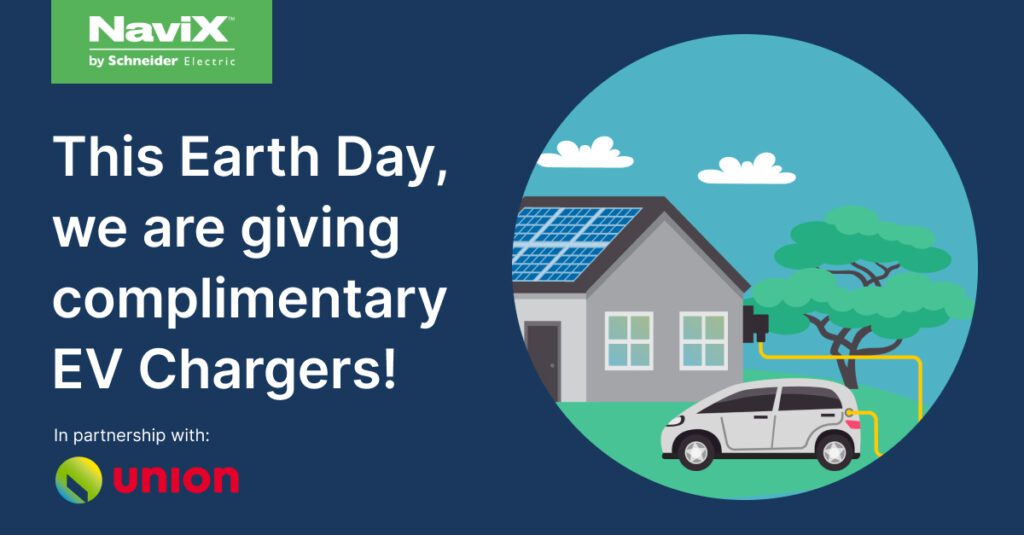
[Singapore, 22 April] – Union Solar (“Union”) and NaviX Solutions (“NaviX”) are delighted to announce an innovative joint promotion, offering customers a fantastic opportunity to embrace sustainability while enhancing their energy independence. Under this collaborative effort, customers who sign up for a Solar PV System installation from Union will receive a complimentary Schneider Electric (“SE”) EV Charger provided by NaviX.

This exclusive promotion is designed to accelerate the adoption of renewable energy solutions while incentivising the transition to electric vehicles (“EVs”), thereby fostering a greener and more sustainable future. By leveraging solar energy to power both households and EVs, customers can significantly reduce their carbon footprint and decrease reliance on non-renewable energy sources.

Union’s Solar PV Systems are renowned for their efficiency, durability, and cutting-edge technology. With a steadfast commitment to quality and customer satisfaction, Union ensures seamless installation and reliable performance, drawing by years of expertise in the solar energy industry.

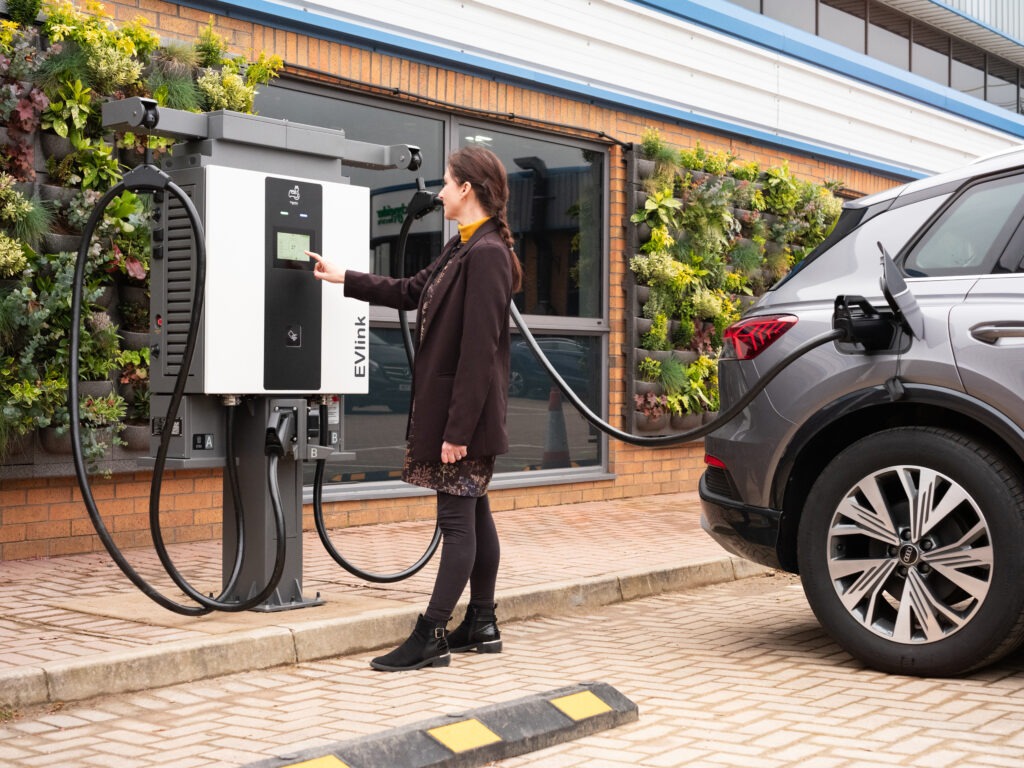
NaviX complements the Solar PV Systems by providing Schneider Electric EV Chargers, designed to deliver reliable charging for EVs. With a focus on innovation and safety, the EV Chargers are high quality and compact, catering to a wide range of EV models and adhering to IEC standards.

This joint promotion is further bolstered by UOB’s U-Solar programme, the first integrated solar energy financing platform across UOB’s key markets in Southeast Asia. Through U-Solar, homeowners can experience the simplicity of identifying solar partners, including up to 36 months of interest-free monthly payments, while enjoying significant savings on their electricity bills.

“Our U-Solar programme was designed to be a convenient one-stop platform for homeowners seeking solar installation. The programme brings together an ecosystem of trusted partners to help homeowners in their energy transition towards a more sustainable lifestyle while providing them with financial incentives. UOB’s comprehensive suite of sustainable financing solutions are aimed at empowering our clients, both businesses and homeowners, to integrate sustainability into their daily lives and drive a positive environmental change.” said Jasper Wong, Head of Real Estate & Hospitality and Construction & Infrastructure at UOB, Sector Solutions Group.

Ellen Teo, CEO of Union Energy Group, expressed enthusiasm about the partnership, stating, “We are thrilled to partner with NaviX Solutions to offer this compelling promotion, which underscores our shared commitment to sustainability and innovation. By leveraging our expertise in solar energy alongside with NaviX Solutions’ eMobility and infrastructure solutions, we aim to empower customers to embrace renewable energy solutions while enjoying the benefits of EV ownership.”

Peter Goh, CEO at NaviX, echoed the sentiment, saying, “At NaviX Solutions, we are passionate about driving the adoption of EVs and supporting the infrastructure needed for widespread usage. Collaborating with Union enables us to provide our customers a comprehensive solution that not only enables clean energy generation but also facilitates the transition to electric transportation.”

Customers interested in seizing this exclusive promotion are encouraged to contact Union or NaviX for further details. Do not miss out on this opportunity to embrace sustainability and enjoy the convenience of EV charging at home!

About Union Solar:

With a legacy of over four decades, Union Energy Corporation Pte Ltd (“Union” or the “Company”) stands as a respected entity in the Singapore energy sector. Our renewables division, Union Solar, is dedicated to the solarization of commercial, industrial, and residential properties. Serving as a solar developer, asset owner, and operator in the solar domain, we are committed to enhancing quality of life by facilitating convenient access to clean energy for businesses and consumers, thus fostering a path towards sustainability.

For more information, please visit: https://unionpower.com.sg/

About NaviX Solutions:

Headquartered in Singapore and jointly incubated by Schneider Electric and Singapore’s Economic Development Board, Navix Solutions Pte Ltd is a first-to-market provider of cleaner, greener and smarter Infrastructure-as-a-Service (“IaaS”), enabling decarbonisation and accelerating the energy transition.

For more information on NaviX Solutions, please visit www.navixsolutions.com

Media Contact

Ethan Tan

Head of Marketing Communications

NaviX Solutions Pte Ltd

Email: ethan.tan@navixsolutions.com

Estee Ho

Assistant Marketing Manager, Union

Email: estee.ho@unionpower.com.sg

Joint Collaboration: Complimentary EV charger with every Solar PV installation Read More »

ESG AT NAVIX

ESG at NaviX: Beach Clean Up

ESG Beach Cleanup for NaviX

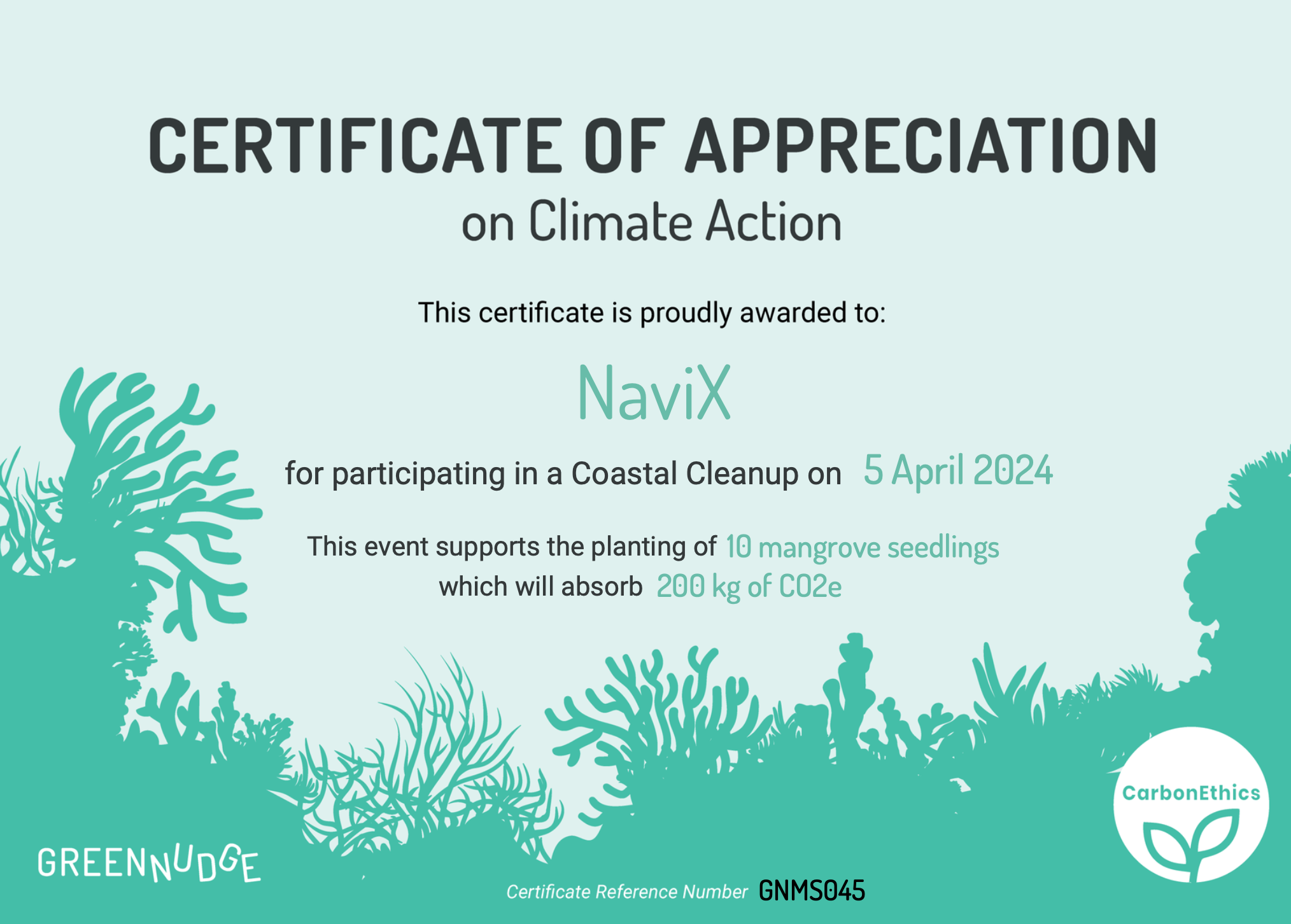
As part of the upcoming Earth Day campaign, we recently gathered 13 volunteers from NaviX Solutions to come together with local social enterprise, GreenNudge, to undertake a beach clean-up initiative along the pristine shores of Changi Beach. The clean-up resulted in the removal of a staggering 73kg of trash, marking a significant contribution to the preservation of marine ecosystems.

Changi Beach, renowned for its natural beauty and tranquil environment, has unfortunately fallen victim to the scourge of marine debris, with litter washing ashore and posing a threat to the delicate balance of its ecosystem. The area that we focused was within 5 mins away from Changi Beach Carpark 7, a popular spot for intertidal walk.

For many of us, this was our first experience participating in a beach clean-up activity. We managed to witness first-hand the impact of human activity on the environment. Armed with gloves, bags and tongs, we combed through the sands and beach weeds, meticulously picking up discarded plastic bottles, styrofoam boxes, and other forms of debris.

“It was truly an eye-opening experience to see the amount of litter that accumulates on our beaches,” remarked Wang Yichao, Head of Application Centre “But being able to actively contribute to cleaning it up made me realize the importance of individual actions in safeguarding our planet.”

Kenny Koh, Chief Financial Officer of NaviX Solutions expressed gratitude for the opportunity to engage in meaningful environmental work, stating, “As someone who had never participated in a beach clean-up before, this experience was incredibly rewarding. It’s inspiring to see how small actions can have a huge impact. We should definitely do more of such vital and impactful initiatives. “

As the clean-up drew to a close and the last traces of litter were removed from the shoreline, we reflected on the significance of our actions and the importance of preserving our natural heritage for future generations. NaviX Solutions reaffirmed its commitment to environmental conservation, pledging to continue supporting initiatives aimed at protecting our planet’s precious ecosystems. By harnessing the collective power of individuals and organizations alike, we strive to create a more sustainable and resilient world for all.

ESG at NaviX: Beach Clean Up Read More »

Scroll to Top