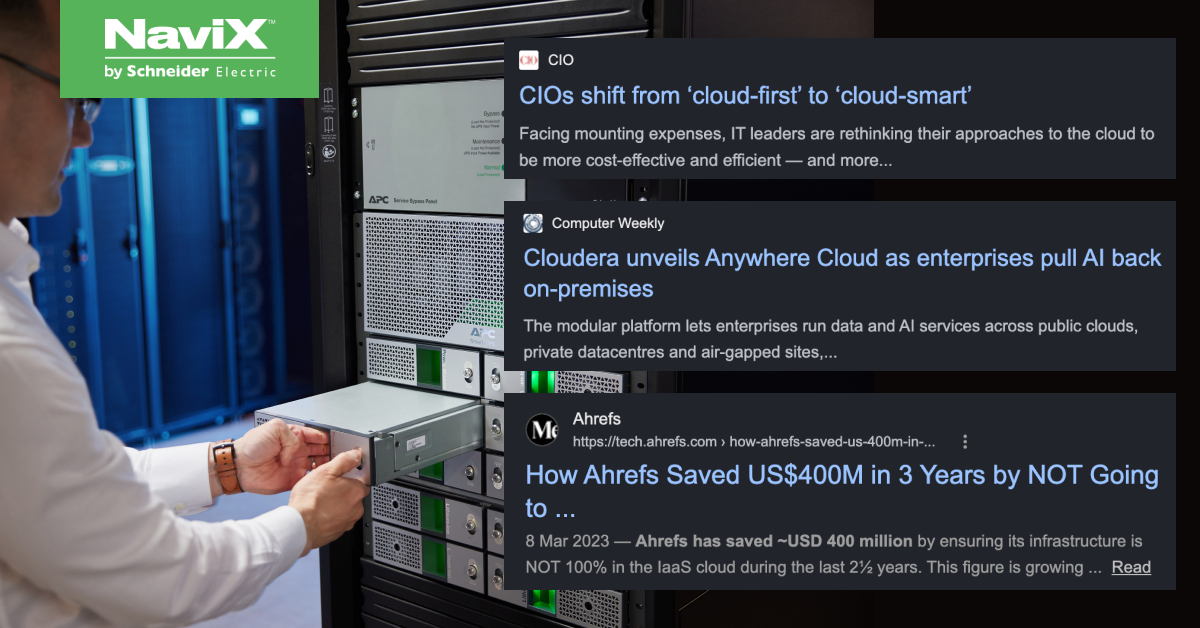

The CIO’s playbook for hybrid cloud amid rising AI adoption Cloud repatriation is back on the CIO’s agenda. Forrester’s Cloud Survey found …
Navigating Singapore’s DC Scarcity: From Crowded Colos to In-House Strains
Singapore’s data centre market has never been busier — or harder to get into. For enterprises trying to secure capacity, or IT teams quietly absorbing the strain across their own sites, scarcity isn’t an abstract market condition. It shows up in three very practical ways: not enough colocation space, not enough hands to run in-house infrastructure well, and hidden costs that only surface years into ownership.
Colocation Capacity Shortage
The scarcity has structural roots. Singapore paused new data centre construction in 2019, concerned that facilities already consumed roughly 7% of national electricity. The moratorium held until 2022, when regulators introduced a selective approval regime — the Data Centre Call for Application (DC-CFA) — that only releases new capacity to operators meeting strict sustainability and efficiency criteria.
The effect on the ground: colocation vacancy sat at just 1.4% as of December 2024, among the tightest in Asia Pacific, and industry outlooks for 2026 still describe supply as structurally low, with available space too fragmented for many large deployments. Colocation now runs among the most expensive in the world at roughly USD 13.80 per watt, and with power availability now the binding constraint across the region, even newly approved capacity takes years to materialise.
Enterprises with latency-tolerant workloads are increasingly looking across the Causeway, where Johor’s data centre capacity has grown to over 1,110MW operational. But for workloads that need to stay onshore for compliance or data residency reasons, that escape valve isn’t always available — which pushes more enterprises back toward running infrastructure themselves.
Manpower Limits for On-Premise Execution Across Multi-Sites
Running one server room is manageable. Running several — branches, warehouses, regional offices — each needing the same power, cooling, and monitoring discipline, is a different problem. Singapore’s tropical humidity (75–95% year-round) makes it harder still: rooms fitted into buildings never designed for them need specialist, recurring attention, not a one-time setup.
Multiply that across sites and the requirement stops being “an IT generalist checks in occasionally” and becomes a standing operational function — someone on call for fault response and maintenance at every site. Most IT teams were never resourced for this; the electrical, mechanical, and environmental skill set involved is scarce industry-wide.
Lifecycle Cost / TCO Blind Spots
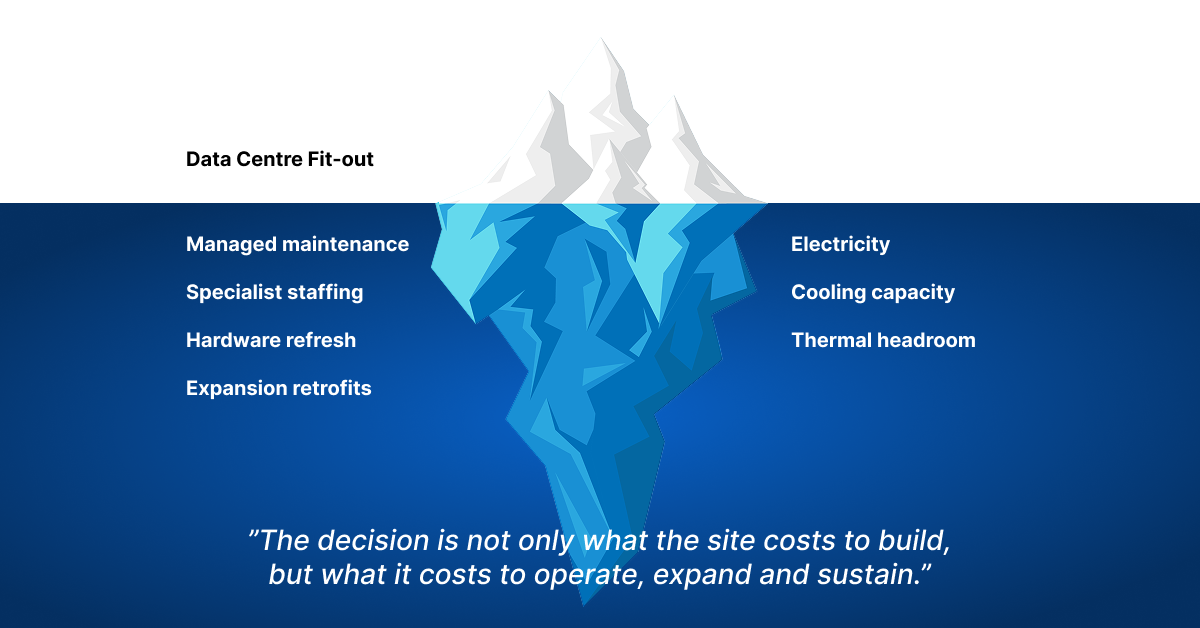
The sticker price is rarely the real cost. A typical fit-out might budget 5 to 6 figures for cooling and power alone, before the electricity, maintenance, and eventual hardware refresh that follow for years after. A common, costly mistake: cooling sized for today’s rack load with no thermal headroom for tomorrow’s, forcing an expensive retrofit the moment compute needs grow.
Ongoing costs compound it — managed maintenance can run 3 to 4 figures a month per site, or an unbudgeted headcount cost if kept in-house. None of this shows up in the initial capital estimate, and by the time it surfaces, it’s already locked in.
Closing The Gap
None of these three pressures are solved by choosing between colocation and on-premise — they’re solved by rethinking how infrastructure gets delivered in the first place. At NaviX Solutions, we see this shift already underway: enterprises moving from owning and staffing their infrastructure to subscribing to it as an outcome, with power, cooling, and monitoring engineered and maintained as a service rather than a one-off capital project.
NaviX Solutions provides zero-CAPEX, subscription-based critical power and cooling solutions for Singapore’s enterprises and commercial building operators
You may like:
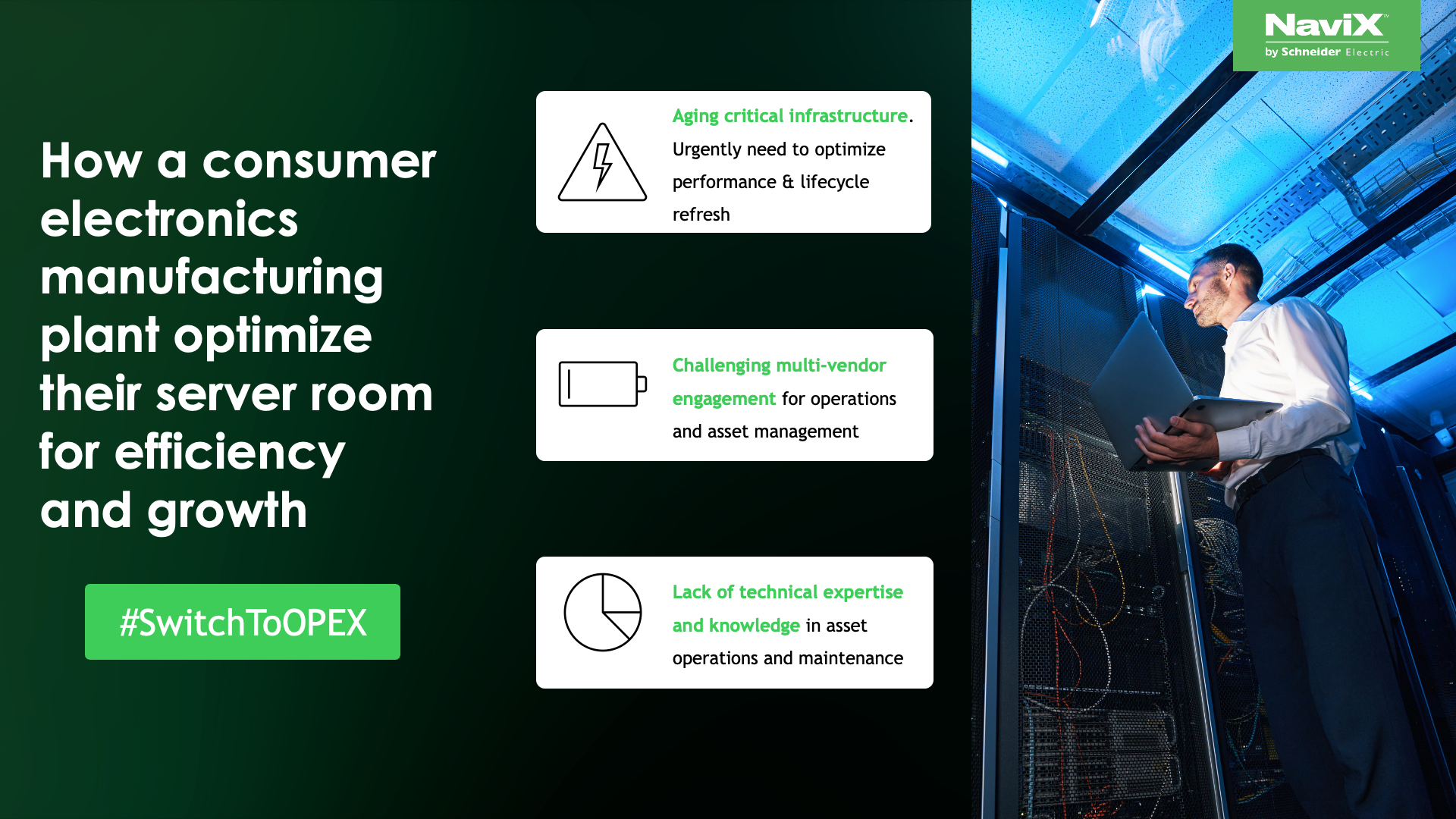
How a consumer electronics manufacturing plant optimize their server room for efficiency and growth Explore Enterprise DC as a Service Learn more: …
Learn more:
Enterprise DC as-a-Service
Critical IT Power as-a-Service
Critical IT Cooling as a Service
UPS Trade-In Program
Navigating Singapore’s DC Scarcity: From Crowded Colos to In-House Strains
Singapore’s data centre market has never been busier — or harder to get into. For enterprises trying to secure capacity, or IT teams quietly absorbing the strain across their own sites, scarcity isn’t an abstract market condition. It shows up in three very practical ways: not enough colocation space, not enough hands to run in-house infrastructure well, and hidden costs that only surface years into ownership.
Colocation Capacity Shortage
The scarcity has structural roots. Singapore paused new data centre construction in 2019, concerned that facilities already consumed roughly 7% of national electricity. The moratorium held until 2022, when regulators introduced a selective approval regime — the Data Centre Call for Application (DC-CFA) — that only releases new capacity to operators meeting strict sustainability and efficiency criteria.
The effect on the ground: colocation vacancy sat at just 1.4% as of December 2024, among the tightest in Asia Pacific, and industry outlooks for 2026 still describe supply as structurally low, with available space too fragmented for many large deployments. Colocation now runs among the most expensive in the world at roughly USD 13.80 per watt, and with power availability now the binding constraint across the region, even newly approved capacity takes years to materialise.
Enterprises with latency-tolerant workloads are increasingly looking across the Causeway, where Johor’s data centre capacity has grown to over 1,110MW operational. But for workloads that need to stay onshore for compliance or data residency reasons, that escape valve isn’t always available — which pushes more enterprises back toward running infrastructure themselves.
Manpower Limits for On-Premise Execution Across Multi-Sites
Running one server room is manageable. Running several — branches, warehouses, regional offices — each needing the same power, cooling, and monitoring discipline, is a different problem. Singapore’s tropical humidity (75–95% year-round) makes it harder still: rooms fitted into buildings never designed for them need specialist, recurring attention, not a one-time setup.
Multiply that across sites and the requirement stops being “an IT generalist checks in occasionally” and becomes a standing operational function — someone on call for fault response and maintenance at every site. Most IT teams were never resourced for this; the electrical, mechanical, and environmental skill set involved is scarce industry-wide.
Lifecycle Cost / TCO Blind Spots
The sticker price is rarely the real cost. A typical fit-out might budget 5 to 6 figures for cooling and power alone, before the electricity, maintenance, and eventual hardware refresh that follow for years after. A common, costly mistake: cooling sized for today’s rack load with no thermal headroom for tomorrow’s, forcing an expensive retrofit the moment compute needs grow.
Ongoing costs compound it — managed maintenance can run 3 to 4 figures a month per site, or an unbudgeted headcount cost if kept in-house. None of this shows up in the initial capital estimate, and by the time it surfaces, it’s already locked in.
Closing The Gap
None of these three pressures are solved by choosing between colocation and on-premise — they’re solved by rethinking how infrastructure gets delivered in the first place. At NaviX Solutions, we see this shift already underway: enterprises moving from owning and staffing their infrastructure to subscribing to it as an outcome, with power, cooling, and monitoring engineered and maintained as a service rather than a one-off capital project.
NaviX Solutions provides zero-CAPEX, subscription-based critical power and cooling solutions for Singapore’s enterprises and commercial building operators
Learn more:
Enterprise DC as-a-Service
Critical IT Power as-a-Service
Critical IT Cooling as a Service
UPS Trade-In Program