

Blog
Low-Hanging Fruits for Singapore’s Mandatory Energy Improvement (MEI) Compliance
What Building Owners Can Do Now
Singapore’s new Mandatory Energy Improvement (MEI) Regime marks a pivotal step forward in the nation’s decarbonisation journey. For the first time, energy efficiency isn’t just encouraged — it’s required.
Under the MEI regime, owners of energy-intensive buildings need to appoint a qualified professional mechanical engineer or registered energy auditor to carry out an energy audit and develop an Energy Efficiency Improvement Plan (EEIP) to reduce the building’s energy use intensity (EUI) by at least 10% from pre-audit levels.
For building owners and facility managers, this raises an important question: How can we achieve compliance efficiently — without heavy capital expenditure or operational disruption?
The answer lies in targeting low-hanging fruits: simple, cost-effective measures that can deliver real energy savings and measurable performance improvements right away.
Why Start with “Low-Hanging Fruits”?
When the Building and Construction Authority (BCA) identifies a building as “energy-intensive”, the building owner will be required to conduct an energy audit and implement efficiency measures within three years.
That sounds like a long runway — but those who act early stand to benefit the most.
- They gain control of their data and energy profile before audits begin.
- They can implement improvements gradually without disrupting operations.
- And they’re more likely to unlock quick savings long before regulatory deadlines.
In our experience, even small operational changes can deliver 5–15% energy savings with minimal cost. Starting small also builds internal momentum — helping organisations shift from reactive compliance to proactive sustainability management.
1. Optimise Your HVAC Systems
HVAC systems often account for 40–60% of a building’s total energy consumption. Even minor inefficiencies — such as incorrect setpoints, poor chiller sequencing, or sensor faults — can significantly increase energy use.
Quick wins:
- Recalibrate chilled water systems.
- Check for faulty valves and sensors.
- Adjust set points based on occupancy data.
Why it matters:
Optimising HVAC performance can yield a 5–10% immediate energy reduction, often without requiring equipment replacement. Continuous monitoring tools help sustain this improvement over time.
2. Fix What’s Broken (Even the Small Stuff)
Energy waste often comes from hidden issues: lights left on, malfunctioning dampers and many others. Implementing a fault detection and diagnostics (FDD) process can quickly identify and correct such inefficiencies.
Quick wins:
- Replace faulty sensors.
- Integrate alarms or alerts for abnormal energy use patterns.
- Review equipment scheduling with actual operating use.
3. Upgrade Lighting System
Lighting retrofits are still one of the fastest ways to reduce energy use. Switching to LED lighting, paired with occupancy and daylight sensors, can cut lighting energy use by 30–50%.
Quick wins:
- Swap out conventional fittings for LEDs.
- Introduce motion or daylight sensors.
- Implement zone-based controls in low-traffic areas.
- Prioritise high traffic zones first, then expand building wide.
- Combine upgrades with smart control for better demand management.
4. Engage Occupants and Operations Team
Sometimes the biggest changes come from people, not systems. Small operational changes, when consistently applied, compound into measurable energy gains.
Quick wins:
- Set clear internal energy goals.
- Provide a real-time dashboard to the facilities team for visualisation of energy consumption.
- Schedule cooling or lighting systems according to occupancy trends.
Sustained engagement builds a culture of efficiency — essential for meeting and maintaining MEI targets.
5. Keep It Continuous — Don’t “Set and Forget”
The MEI regime doesn’t just ask for improvement; it requires sustained performance over time (at least one year). That means once your building achieves its target EUI reduction, it must maintain that performance.
This makes continuous monitoring essential for compliance verification and early fault detection.
Potential benefits of continuous monitoring:
- Tracks energy consumption trends in real time.
- Supports audit documentation with verified data.
- Detects performance drift before it affects compliance status.
- Digital platforms that integrate with existing Building Management Systems (BMS) make this process seamless and data-driven.
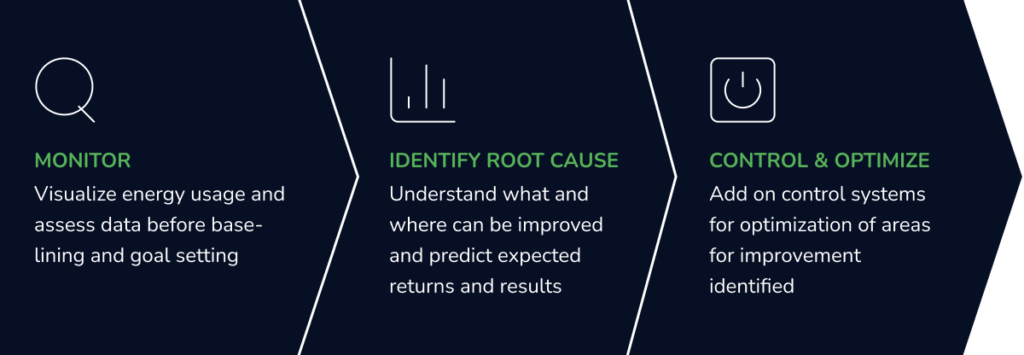
Monitoring is only the first step. Understanding how much electricity your building consumes provides the baseline needed for MEI readiness. But data alone doesn’t reduce energy use.
The next step is to identify the root causes behind high consumption patterns, evaluate which improvements offer the strongest returns. The real impact begins after monitoring, through optimisation. Deploying intelligent control systems like the Schneider Electric’s EcoStruxure Building Activate, enhancing automation, and tightening equipment scheduling turn raw data into measurable reduction — helping buildings progress from understanding the problem to actively solving it.
Beyond Compliance: Your Roadmap to EUI Reduction
The MEI Regime is not just a compliance requirement — it’s a turning point for how Singapore’s building owners view energy performance.
At NaviX Solutions, we understood that MEI compliance doesn’t always start with major investments. It starts with insight. Understanding your building’s performance today is the fastest route to long-term energy efficiency tomorrow. By focusing on data transparency, smart operations, and continuous optimisation, buildings can stay compliant and achieve long-term cost savings. The key is to start now, with the data and quick wins already within reach.
With the right data, smart solutions, and a partner like NaviX Solutions, you can start achieving results today — with zero upfront investment required.
Choose your low-hanging fruit. Start today.
Talk to us to find out how we can help you on your sustainability journey.
Learn more:


Low-Hanging Fruits for Singapore’s Mandatory Energy Improvement (MEI) Compliance
What Building Owners Can Do Now
Singapore’s new Mandatory Energy Improvement (MEI) Regime marks a pivotal step forward in the nation’s decarbonisation journey. For the first time, energy efficiency isn’t just encouraged — it’s required.
Under the MEI regime, owners of energy-intensive buildings need to appoint a qualified professional mechanical engineer or registered energy auditor to carry out an energy audit and develop an Energy Efficiency Improvement Plan (EEIP) to reduce the building’s energy use intensity (EUI) by at least 10% from pre-audit levels.
For building owners and facility managers, this raises an important question: How can we achieve compliance efficiently — without heavy capital expenditure or operational disruption?
The answer lies in targeting low-hanging fruits: simple, cost-effective measures that can deliver real energy savings and measurable performance improvements right away.
Why Start with “Low-Hanging Fruits”?
When the Building and Construction Authority (BCA) identifies a building as “energy-intensive”, the building owner will be required to conduct an energy audit and implement efficiency measures within three years.
That sounds like a long runway — but those who act early stand to benefit the most.
- They gain control of their data and energy profile before audits begin.
- They can implement improvements gradually without disrupting operations.
- And they’re more likely to unlock quick savings long before regulatory deadlines.
In our experience, even small operational changes can deliver 5–15% energy savings with minimal cost. Starting small also builds internal momentum — helping organisations shift from reactive compliance to proactive sustainability management.
1. Optimise Your HVAC Systems
HVAC systems often account for 40–60% of a building’s total energy consumption. Even minor inefficiencies — such as incorrect setpoints, poor chiller sequencing, or sensor faults — can significantly increase energy use.
Quick wins:
- Recalibrate chilled water systems.
- Check for faulty valves and sensors.
- Adjust set points based on occupancy data.
Why it matters:
Optimising HVAC performance can yield a 5–10% immediate energy reduction, often without requiring equipment replacement. Continuous monitoring tools help sustain this improvement over time.
2. Fix What’s Broken (Even the Small Stuff)
Energy waste often comes from hidden issues: lights left on, malfunctioning dampers and many others. Implementing a fault detection and diagnostics (FDD) process can quickly identify and correct such inefficiencies.
Quick wins:
- Replace faulty sensors.
- Integrate alarms or alerts for abnormal energy use patterns.
- Review equipment scheduling with actual operating use.
3. Upgrade Lighting System
Lighting retrofits are still one of the fastest ways to reduce energy use. Switching to LED lighting, paired with occupancy and daylight sensors, can cut lighting energy use by 30–50%.
Quick wins:
- Swap out conventional fittings for LEDs.
- Introduce motion or daylight sensors.
- Implement zone-based controls in low-traffic areas.
- Prioritise high traffic zones first, then expand building wide.
- Combine upgrades with smart control for better demand management.
4. Engage Occupants and Operations Team
Sometimes the biggest changes come from people, not systems. Small operational changes, when consistently applied, compound into measurable energy gains.
Quick wins:
- Set clear internal energy goals.
- Provide a real-time dashboard to the facilities team for visualisation of energy consumption.
- Schedule cooling or lighting systems according to occupancy trends.
Sustained engagement builds a culture of efficiency — essential for meeting and maintaining MEI targets.
5. Keep It Continuous — Don’t “Set and Forget”
The MEI regime doesn’t just ask for improvement; it requires sustained performance over time (at least one year). That means once your building achieves its target EUI reduction, it must maintain that performance.
This makes continuous monitoring essential for compliance verification and early fault detection.
Potential benefits of continuous monitoring:
- Tracks energy consumption trends in real time.
- Supports audit documentation with verified data.
- Detects performance drift before it affects compliance status.
- Digital platforms that integrate with existing Building Management Systems (BMS) make this process seamless and data-driven.
Monitoring is only the first step. Understanding how much electricity your building consumes provides the baseline needed for MEI readiness. But data alone doesn’t reduce energy use.
The next step is to identify the root causes behind high consumption patterns, evaluate which improvements offer the strongest returns. The real impact begins after monitoring, through optimisation. Deploying intelligent control systems like the Schneider Electric’s EcoStruxure Building Activate, enhancing automation, and tightening equipment scheduling turn raw data into measurable reduction — helping buildings progress from understanding the problem to actively solving it.
Beyond Compliance: Your Roadmap to EUI Reduction
The MEI Regime is not just a compliance requirement — it’s a turning point for how Singapore’s building owners view energy performance.
At NaviX Solutions, we understood that MEI compliance doesn’t always start with major investments. It starts with insight. Understanding your building’s performance today is the fastest route to long-term energy efficiency tomorrow. By focusing on data transparency, smart operations, and continuous optimisation, buildings can stay compliant and achieve long-term cost savings. The key is to start now, with the data and quick wins already within reach.
With the right data, smart solutions, and a partner like NaviX Solutions, you can start achieving results today — with zero upfront investment required.
Choose your low-hanging fruit. Start today.
Talk to us to find out how we can help you on your sustainability journey.